A closer look at your journal

How Mindful estimates calories and macros.

Write what you ate, and Mindful turns your words into a calorie and macro estimate. Your journal brings the food details, portions, and available nutrition sources into the entry, so you can check and adjust the numbers.

1. Review the food, portion, and preparation.

Open Mindful's breakdown to see how it interpreted your entry. Check whether the food is the right product, whether the amount matches your portion, and whether the preparation or additions are represented.

An example from the app

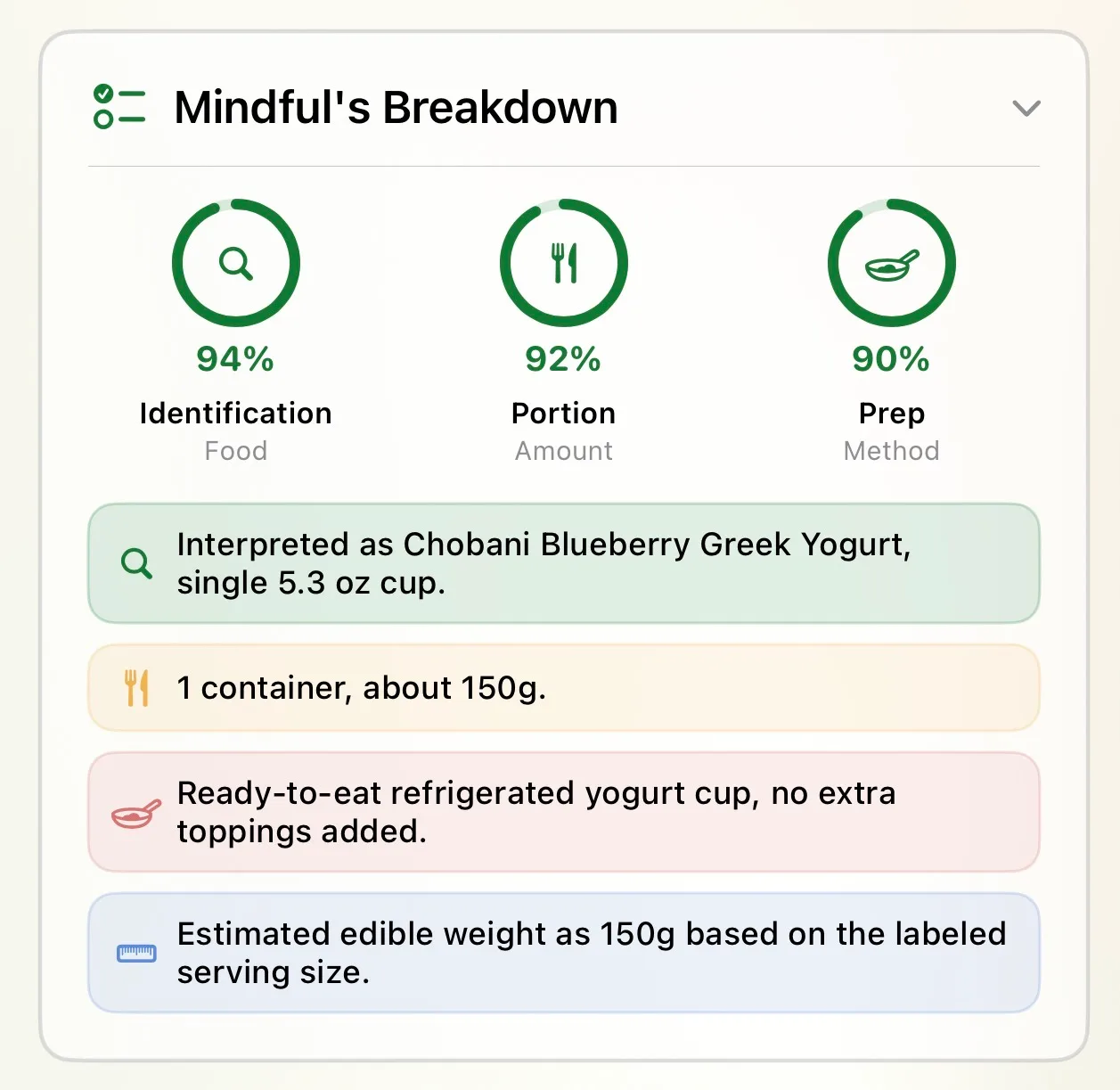
This entry was interpreted as one 5.3 oz cup of Chobani Blueberry Greek Yogurt, about 150 g, with no extra toppings. Those are assumptions to check against what you actually ate.

Confidence scores describe the model's assessment of food identification, portion, and preparation. They are not independently verified accuracy percentages.

Example Mindful breakdown: blueberry Greek yogurt, one 150 g container, with no extra toppings
Example app screen. The scores shown illustrate this entry, not an accuracy benchmark.

2. Check the sources behind the estimate.

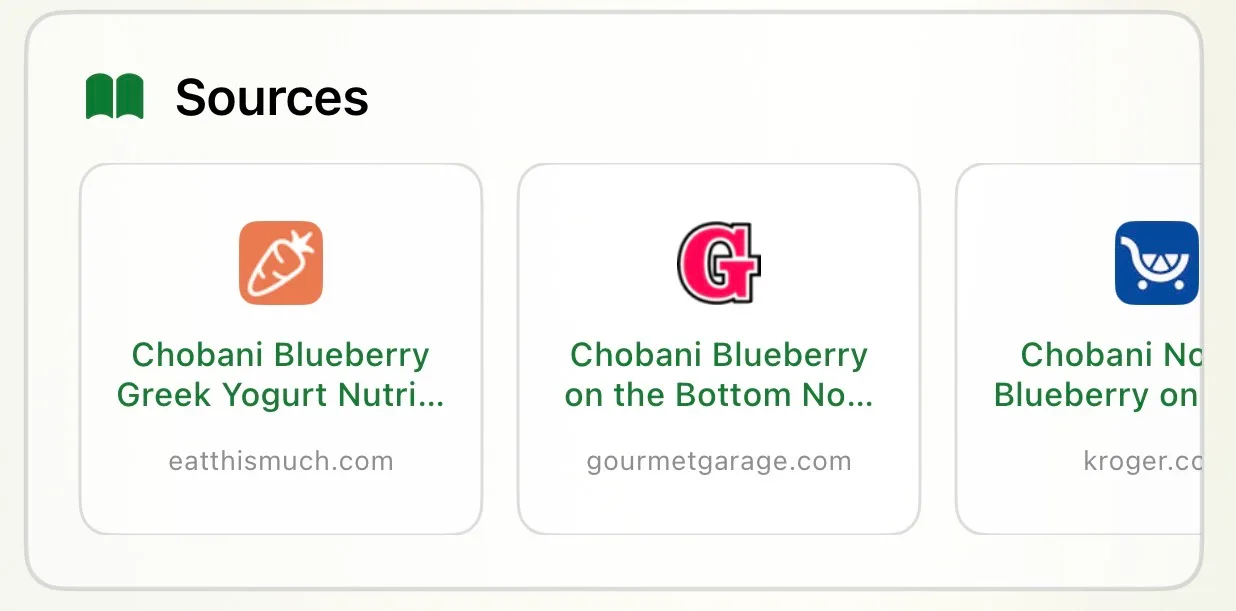
When sources are shown, open them to review the nutrition information used for the entry. Check the product name, serving size, and preparation details. A similar food or another package size can require a correction.

Example source cards for blueberry yogurt from Eat This Much, Gourmet Garage, and Kroger
Source cards from an example entry. The sources available depend on the food and the entry.

3. Adjust the details. Keep your journal useful.

Edit an entry manually or describe a correction with Edit with AI. If the example above missed a topping, you could add it; if the portion was different, you could correct the amount. Review the revised food and nutrition details before saving.

Your journal keeps your meals and daily totals together. Reuse saved meals, review calories and macros, and look back at your progress over time.

Put the details into practice

Three meals. Different details to check.

The yogurt example starts with the app screen above. The homemade and restaurant meals are illustrative scenarios, not recorded app tests. The correction wording shows how to add known details; review the resulting entry before saving.

Packaged food

A yogurt cup

The app screen above interprets the entry as one 150 g cup of Chobani Blueberry Greek Yogurt, with no toppings.

What to check
Compare the product, flavor, package size, and serving on the label with the entry. A similar name does not necessarily mean the same nutrition information.
Example correction
I ate 100 g of the 150 g cup. No toppings.
How to cross-check
For this example correction, 100 ÷ 150 = two-thirds of the cup. Compare the entry with two-thirds of the label's full-cup values. This is a serving-size calculation, not a measured Mindful result.

Homemade meal · illustrative scenario

Chicken and rice

A description such as “one bowl of chicken and rice” leaves the ingredient amounts and preparation open to interpretation.

What to check
Check the cooked amounts, cooking oil, sauces, and how much of the recipe you ate. Use details you actually know; a bowl is not a fixed portion.
Example correction
The bowl had 150 g cooked rice and 100 g cooked chicken, plus one teaspoon of olive oil.
How to cross-check
Compare each ingredient with the relevant label or nutrition source using the same cooked or uncooked basis. For a shared recipe, account for your portion of the whole dish.

Restaurant meal · illustrative scenario

A chicken Caesar salad

A meal photo can show salad ingredients while leaving the dressing amount, preparation, and portion unclear.

What to check
If the restaurant publishes nutrition information, match the exact dish and size. Check whether dressing, toppings, and sides are included in those values.
Example correction
The dressing came separately and I used half. There were no croutons.
How to cross-check
Use the restaurant's matching information when available. Otherwise, review the assumptions and keep the result as an estimate; a photo alone cannot establish an exact calorie count.

For packaged foods, start with reading the nutrition label. For meals away from home, see our guide to eating out.

Start with your next meal.

Write what you ate, review the details, and build a journal you can come back to.

Download on the App Store