Raw vs. Cooked Weight: How to Log Rice, Pasta, and Chicken
Should you weigh food before or after cooking? Match your food entry to its weight, with clear examples for rice, pasta, chicken, and meal prep.
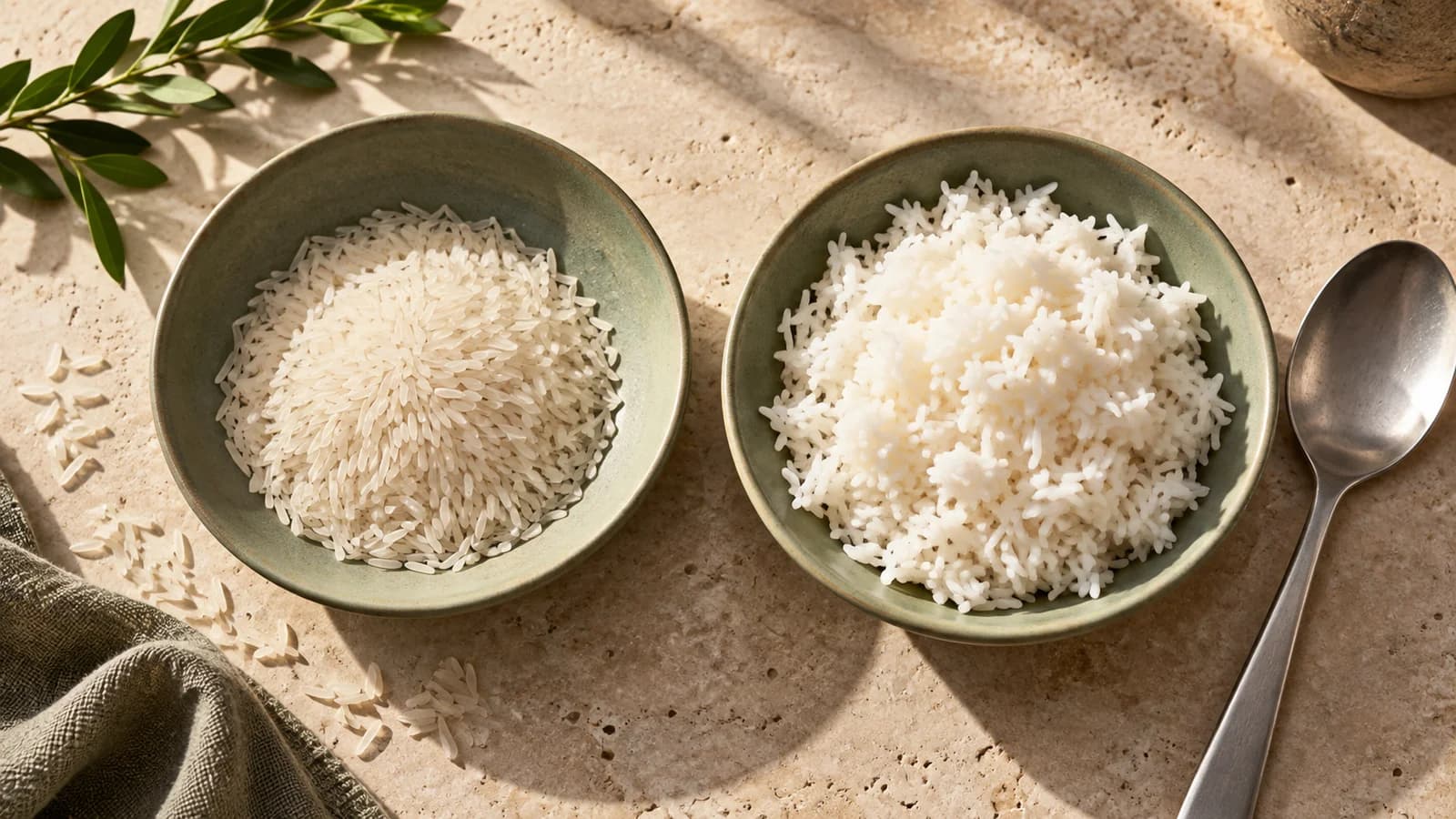
Try the Raw & Cooked Weight Converter to work from your own measured batch or explore a clearly labeled rough estimate.
You can weigh food before or after cooking. The important part is matching the weight to the right nutrition entry: dry rice with a dry-rice entry, cooked rice with a cooked-rice entry, and cooked chicken with a cooked-chicken entry. Using a cooked weight with a raw entry is where the calculation goes wrong.
A pot of rice gets heavier as it absorbs water. A chicken breast usually gets lighter as it cooks. Neither change means you can compare equal weights of the raw and cooked food as if they were the same portion. USDA describes moisture loss during cooking as one reason meat's weight changes.1
This guide shows how to keep those differences straight, whether you use a kitchen scale, a food database, or a photo estimate. The batch numbers below are worked examples, not results from a kitchen experiment.
Should you weigh food raw or cooked?
Use whichever method fits the information you have. Before cooking, a package's gram-based serving size is often convenient. After cooking, a matching cooked-food entry may be easier. Be consistent about what the number represents.
| What is on your scale? | Entry to choose | Detail to check |
|---|---|---|
| Uncooked rice or pasta | Dry or uncooked rice/pasta | Match the type and package when possible. |
| Cooked, drained rice or pasta | Cooked rice/pasta | Check whether oil or sauce is included. |
| Raw boneless chicken breast | Raw chicken breast, meat only | Skin, bones, and added solution can change the comparison. |
| Cooked chicken breast | Cooked chicken breast with the closest preparation | Do not use the original raw weight again. |
| A portion of a mixed dish | Your saved recipe or a matching prepared dish | Specify the amount of the finished dish you ate. |
| A packaged ready-to-eat meal | That product's Nutrition Facts | Check servings per container and any “as prepared” column. |
On US labels, the serving size and servings per container tell you what the nutrition numbers describe. A serving size is not a recommendation for how much you should eat. Read any preparation instructions or separate prepared-food values before assuming the label applies to the food on your plate.2
For a refresher, see how to read a nutrition label.
Rice: the dry serving and cooked serving are different weights
Imagine your rice package lists 160 calories per 45g dry serving. You cook 180g of that dry rice in water and the finished batch weighs 540g.
The calculation is:
- Dry rice used: 180 ÷ 45 = 4 labeled servings.
- Estimated batch calories: 4 × 160 = 640 calories.
- Your cooked portion: 135g out of 540g = one quarter of the batch.
- Your portion's estimated calories: 640 × 135 ÷ 540 = 160 calories.
| Stage in this example | Weight | Estimated calories |
|---|---|---|
| Rice before cooking | 180g dry | 640 |
| Entire batch after cooking in water | 540g cooked | About 640 |
| One quarter of the finished batch | 135g cooked | About 160 |
This simplified recipe calculation assumes no calorie-containing additions and no meaningful food loss. Real cooking and draining can introduce small differences. The useful point is that 135g of this cooked batch is not 135g of dry rice.
If you accidentally entered 135g as dry rice using that label, the app would calculate 480 calories. The rice has not changed into a different food; the weight and entry no longer describe the same thing.
The three-to-one yield in this example is not a universal conversion. Rice variety, water, cooking time, draining, and resting change the finished weight. Weigh your own batch when you want to use this method.
Pasta: start with the label, then divide the finished batch
Suppose a dry-pasta label says 200 calories per 56g serving. You use 224g dry pasta, giving an estimated 800 calories before sauce. After cooking and draining, the batch weighs 560g.
A 140g portion is one quarter of that batch, so it contains about 200 calories from the pasta. Add sauce, cheese, meat, or oil separately, or include them in a recipe for the entire finished dish.
Avoid the shortcut “one cup of pasta is always one serving.” A cup of loosely packed penne and a cup of compact spaghetti do not necessarily weigh the same. If you only have a cup measure, select a cooked entry that describes the pasta and portion as closely as possible, and accept a less precise estimate.
Chicken: cooking changes the weight, and sometimes more than water
Chicken commonly loses moisture during cooking. That means 4 ounces of cooked chicken generally represents more starting meat than 4 ounces of raw chicken. USDA also notes that preparation affects moisture loss.1
For meal prep, you have two practical options:
- Weigh the raw portions before cooking. Log each portion with an appropriate raw entry and account for other ingredients. This is convenient when you cook and eat each portion separately.
- Weigh the cooked portion you eat. Use a cooked entry matching the cut, skin, and preparation. This is useful when you have a tray of cooked chicken to divide later.
Do not assume that cooking always preserves every calorie in the starting meat. Fat and juices may be discarded, skin may be removed, and oil or sauce may be added. A raw-ingredient recipe calculation is an estimate of the finished dish, especially when substantial drippings are left behind.
If you only know the cooked weight, a matching cooked-food entry is usually more defensible than multiplying by a universal raw-to-cooked ratio. For serving ideas, see high-protein foods and 30g protein portions.
The batch method for soups, chili, and meal prep
When the whole dish is reasonably well mixed, this formula is useful:
Portion calories = estimated recipe calories × portion weight ÷ total finished recipe weight.
Weigh the empty pot or storage container first so you can subtract it. Add the recipe's ingredients once, then weigh the finished edible dish. Use the same unit for your portion and the total batch: grams are convenient, but ounces also work.
For example, a dish estimated at 2,400 calories that weighs 1,600g after cooking contains about 1.5 calories per gram. A 350g portion is about 525 calories. That does not make the estimate laboratory-precise; it makes the division consistent.
The method works best when portions have a similar mix of ingredients. A container filled mostly with chicken and one filled mostly with rice will not have equal nutrition per gram. Divide those components separately or portion the ingredients evenly before using the calculation.
What about oil, marinades, and sauces?
Include ingredients that become part of the meal. If you mix oil through cooked rice and eat the whole batch, include it in the recipe. If marinade or rendered fat remains in the pan, the amount eaten is uncertain. Do not invent an exact absorption percentage from a photo.
For a repeatable everyday estimate, record how you handled the ingredient and use the same reasonable approach next time. If the uncertainty matters, measure what was added and what was left rather than expecting the app to know.
How to describe a meal to an AI calorie tracker
Give the details a photo cannot reliably establish:
“I ate 5 oz cooked, skinless chicken breast and 1 cup cooked white rice. The rice was cooked in water. I added 1 teaspoon of olive oil to my portion.”
That is more informative than “chicken and rice.” Review whether the estimate used cooked weights, included the oil, and counted only your portion. If you used a specific package, its label can be a better match than a generic entry.
Mindful lets you describe a meal and review or correct the resulting estimate. See how calorie estimates work for the assumptions to check. A photo remains an estimate; it does not measure the water content, hidden ingredients, or exact weight of your food.
Frequently asked questions
Does cooked rice have fewer calories than raw rice?
Per equal gram weight, plain cooked rice is less calorie-dense because it contains more water. That does not mean cooking a particular dry portion in water removes most of its calories. Compare the original portion with the whole cooked amount it produces.
Are pasta calories on the box for dry or cooked pasta?
Read your package. Many dry-pasta labels describe the dry product and may also provide a prepared amount. Ready-to-eat pasta and prepared meals are different products. Use the wording and serving weight on the label rather than a blanket rule.
Should I log chicken before or after cooking?
Either works if the nutrition entry matches. Raw weight needs a raw entry; cooked weight needs a cooked entry. Also match the cut, skin, and preparation as closely as practical.
What if I forgot to weigh the food before cooking?
Use a matching cooked entry and the portion you ate. You do not need to reconstruct a fictional raw weight. If you know the original ingredient amounts and finished batch weight, the recipe method is another option.
Should I count both the recipe ingredients and the finished meal?
No. That would count the same food twice. Record either your share of the recipe or its individual ingredients for that portion.
Sources and calculation notes
Checked September 9, 2026. All batch weights and label values in the worked examples are hypothetical and chosen to make the arithmetic easy to follow. They are not measured yields or nutrition claims about a particular brand.
Footnotes
-
USDA Food Safety and Inspection Service. Water in Meat and Poultry. ↩ ↩2
-
US Food and Drug Administration. How to Understand and Use the Nutrition Facts Label. ↩