Loading Results...
Find my type
Explore this eating pattern
The Convenience Eater
Dinner should fit the day I actually had.
Practical choicesLow effortReal-life pace
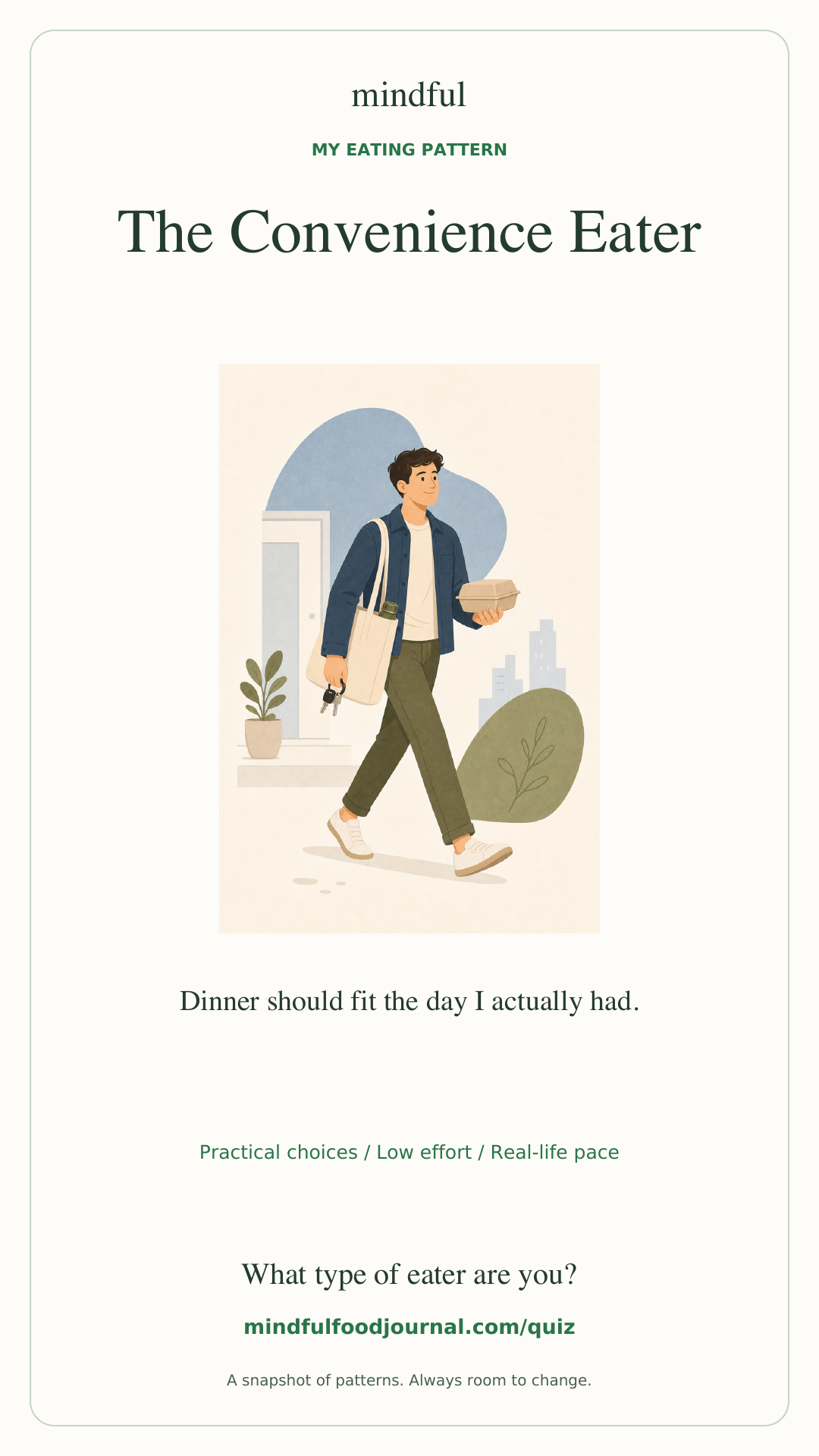
A snapshot of eating patterns, with room to change.
When time, energy, access, or money are limited, the easiest food often makes sense. Convenience is not a character flaw. This week focuses on making a few accessible choices more satisfying and dependable without asking you to build an elaborate meal-prep routine.
A strength to keep
You find workable options in real circumstances. Practicality is a useful foundation for an eating routine you can actually maintain.
One small step
Write down two easy meals you enjoy and can realistically access. Keep them as options for days when deciding feels hard.
Your free 10-page playbook
Your type explained.
Your next seven days planned.
Get your free playbook for The Convenience Eater: everyday examples, small experiments, and a printable seven-day worksheet.
- Recognize the situations that bring your pattern out.
- Try a seven-day plan made for this type.
- Keep a worksheet and a kinder plan for difficult days.
A look inside your actual playbook. Written for this type, with space to make it your own.
Overview
If this sounds like you
If you are The Convenience Eater, you may not feel especially emotional, chaotic, or out of control around food. The issue is more practical than dramatic: the day gets busy, the fridge is not ready, cooking sounds like a second job, and suddenly delivery, packaged food, or whatever is closest becomes the obvious answer.
This pattern often feels less like a food problem and more like a systems problem. You may know what a better choice would be, but knowing does not chop vegetables, buy groceries, or make dinner appear after a long day.
At your best, you are practical. You understand that real life has constraints, and you are not trying to win a meal-prep competition. That is useful. The trouble starts when your environment only offers choices that pull you away from the way you actually want to eat.
Convenience eating can feel especially frustrating because the choice often makes sense in the moment. You are tired, short on time, or unprepared. The easiest option solves the immediate problem, even if it creates a pattern you do not like over the week.
For The Convenience Eater, progress is not about becoming a chef or planning every bite. It is about lowering the friction around the choices you already wish were easier.
What drives it
The mechanism underneath
Eating choices are shaped by logistics, low planning, limited prep energy, and easiest-available food more than hunger, emotion, reward, or social pressure.
Why this happens
Busy days, low energy, or missing groceries make the fastest option feel like the only option.
Planning and prep require executive energy, which can be scarce exactly when you need it.
Food environments are designed to make convenient choices more visible than supportive ones.
Common signs
You rely on takeout, delivery, packaged food, or whatever is closest more often than you intend to.
You have a general idea of what would help, but the setup required feels like the hard part.
Your eating improves quickly when good options are already available and easy to assemble.
Strengths & challenges
What helps you, and where it can get in your way
What works in your favor
You are realistic about energy and time. You do not need food to be precious or perfect, and that practicality can be a strength when it is paired with a few better defaults.
Where it can get in your way
The easiest option can quietly become the repeated option. Over time, convenience can start deciding your nutrition before your goals get a vote.
First steps
What to do with this result this week
The progress trap
The trap is trying to solve a logistics pattern with motivation. Motivation helps for a day or two, but better defaults help when you are tired.
1
Create two fallback meals that require almost no cooking and use foods you actually like.
2
Keep one high-protein convenience option available before you need it.
3
Plan the next food decision only one step earlier: before hunger and fatigue are already in charge.
How Mindful helps
Start building a calmer food system
1
Helps you see which meals are being decided by convenience instead of preference or hunger.
2
Makes quick logging useful even when the meal is takeout, packaged, or imperfect.
3
Supports better defaults by showing which easy options help your goals and which ones keep repeating by accident.
A quick note
This quiz is for self-reflection, not diagnosis or medical advice. If food, tracking, weight, or eating patterns feel distressing or unsafe, consider working with a registered dietitian, clinician, or mental health professional.