Loading Results...
Find my type
Explore this eating pattern
The Intuitive Eater
Room for hunger, enjoyment, and a change of plan.
Body awareFlexible choicesRoom for enjoyment
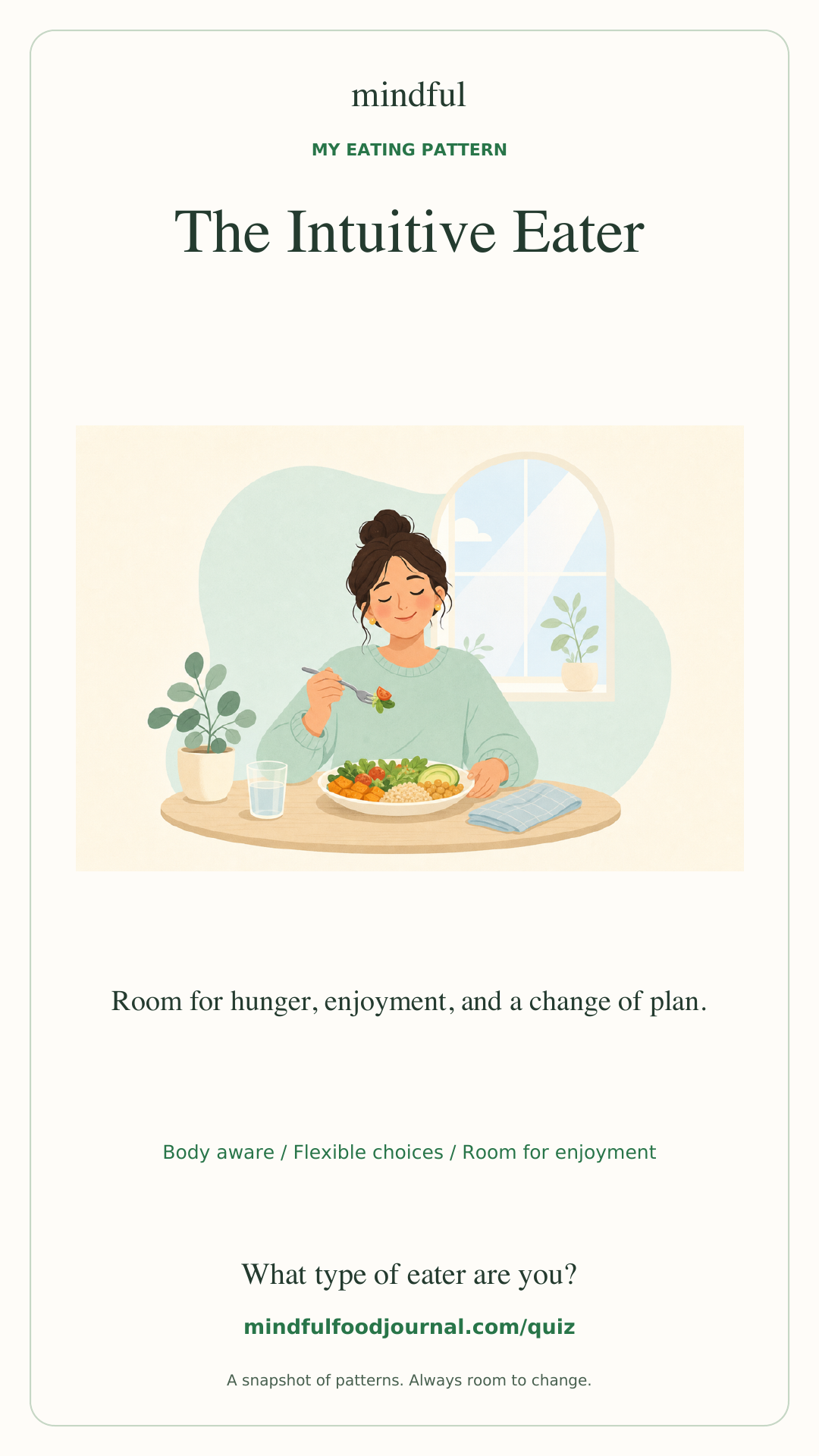
A snapshot of eating patterns, with room to change.
This pattern can include ease around food and room to respond to changing needs. This result is a reflection prompt, not a certification or a better rank than other types. This week explores the conditions that support that ease and what might help when life becomes less predictable.
A strength to keep
You can make room for appetite, enjoyment, and flexibility. Those habits can be supported without needing to perform them perfectly.
One small step
Notice one condition that makes eating feel easier, such as accessible food, enough time, or comfortable company. Make room for it again.
Your free 10-page playbook
Your type explained.
Your next seven days planned.
Get your free playbook for The Intuitive Eater: everyday examples, small experiments, and a printable seven-day worksheet.
- Recognize the situations that bring your pattern out.
- Try a seven-day plan made for this type.
- Keep a worksheet and a kinder plan for difficult days.
A look inside your actual playbook. Written for this type, with space to make it your own.
Overview
If this sounds like you
If you are The Intuitive Eater, food may feel refreshingly normal most of the time. You get hungry, you eat, you get satisfied, you move on. You may enjoy food without needing the entire day to become a storyline about what you did right or wrong.
This result means your answers did not strongly cluster around one of the more disruptive eating patterns. Hunger, fullness, enjoyment, and routine seem to be working together reasonably well most of the time.
Flexibility can help you respond to changing needs. You can also use structure or ask for support when familiar eating patterns feel less straightforward.
That does not mean food is perfect for you in every context. Stress, travel, training goals, social changes, or a chaotic schedule can still throw things off. But your baseline relationship with food seems relatively steady.
For The Intuitive Eater, the goal is to protect what is already working. Awareness should support your instincts, not replace them with a system you never needed.
What drives it
The mechanism underneath
Internal cues are mostly online. You eat when hungry, stop when satisfied, enjoy food, and do not spend huge amounts of mental energy recovering from meals.
Why this happens
You can usually hear hunger and fullness cues before they become extreme.
Food choices are flexible without swinging between strict control and abandon.
You may have routines that support you without needing much conscious effort.
Common signs
You can enjoy food without needing the day to become a nutrition storyline.
You adjust naturally after bigger or smaller meals.
You are curious about nutrition, but not consumed by it.
Strengths & challenges
What helps you, and where it can get in your way
What works in your favor
You have a flexible relationship with food. That is the whole point for many people.
Where it can get in your way
The main risk is assuming intuition stays accurate in every new context. Travel, stress, goals, training changes, or a chaotic schedule can still make awareness useful.
First steps
What to do with this result this week
The progress trap
The trap is over-optimizing something that is already working. If you add tracking, it should serve a clear goal or temporary learning period.
1
Use Mindful as an occasional check-in when your routine changes.
2
Track short experiments, like protein, fiber, or meal timing, instead of tracking everything forever.
3
Keep enjoyment and flexibility as part of the goal, not as things to overcome.
How Mindful helps
Start building a calmer food system
1
Works as a light-touch check-in when your routine changes.
2
Helps you learn nutrition details without turning food into a math exam.
3
Keeps logging optional, quick, and useful when you want more visibility.
A quick note
This quiz is for self-reflection, not diagnosis or medical advice. If food, tracking, weight, or eating patterns feel distressing or unsafe, consider working with a registered dietitian, clinician, or mental health professional.