Should You Track Your Calories? The Evidence-Based Answer
Should you track your calories? The honest, research-backed answer on what the studies show calorie tracking actually does, who it works best for, who should avoid it, and how to do it without making food your personality.
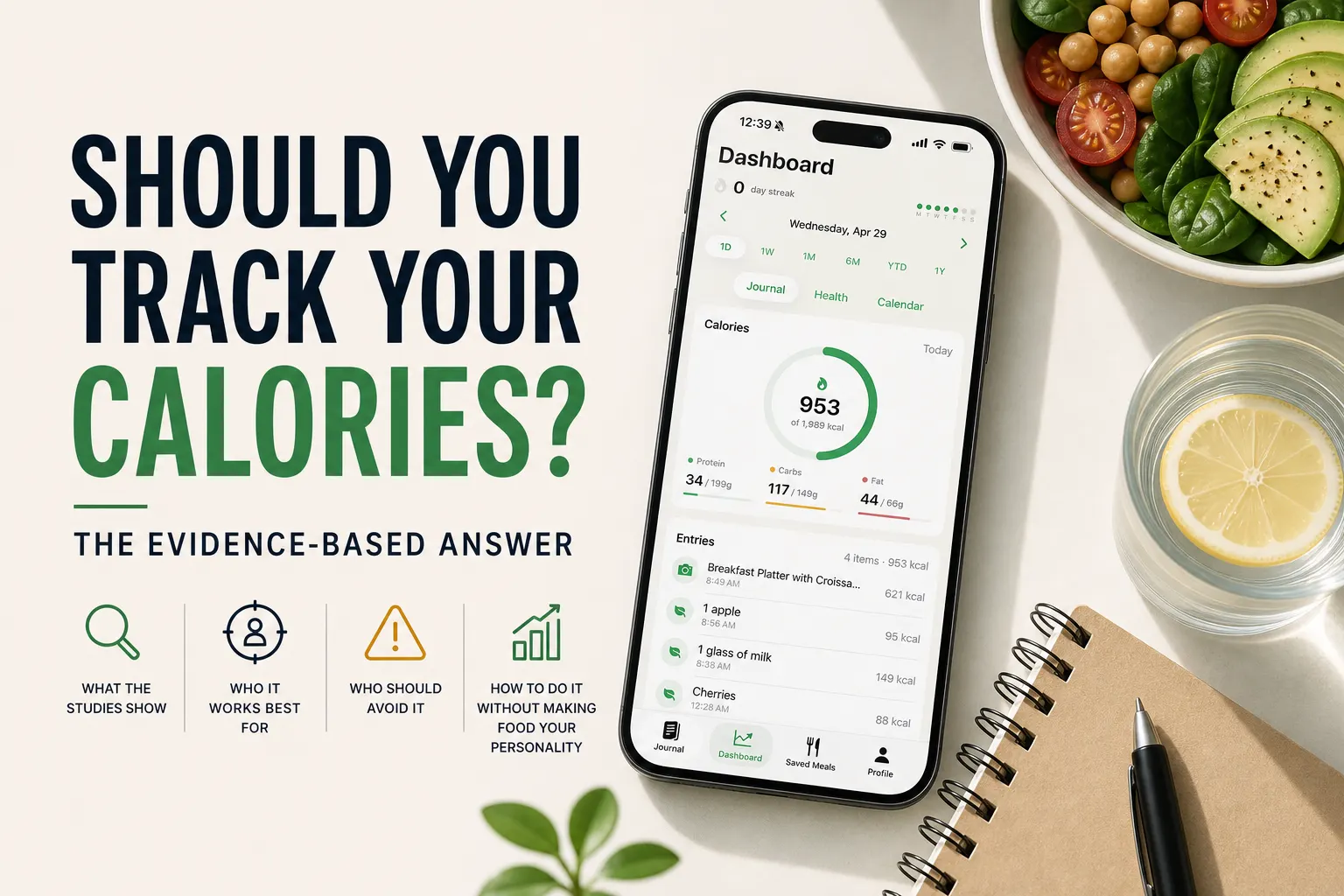
TL;DR. Tracking calories, also called dietary self-monitoring or food logging, is one of the most consistently evidence-backed behavioral tools for weight management. Multiple randomized trials and meta-analyses have shown that people who track lose more weight than those who don't, with effects holding up over months and even years. The benefits go beyond weight: tracking builds awareness of portion sizes, surfaces hidden calorie sources, and provides an objective record that counters the well-documented human tendency to underestimate intake. But tracking isn't the right tool for everyone. It's associated with disordered eating symptoms in some users, particularly those with predisposing risk factors, and the benefits depend heavily on how you track and whether you can sustain it without it becoming a source of anxiety. This article walks through what the research shows, where it falls short, and how to track in a way that actually helps.
A lot of the discourse around calorie tracking is binary: either it's the cornerstone of weight loss success, or it's a one-way ticket to disordered eating. The actual research is more interesting than either of those positions, and more useful.
This article covers what tracking calories does, based on randomized controlled trials, large cohort studies, and behavioral research going back three decades, and where it falls short. It also addresses the counter-evidence honestly, because the strongest case for tracking is one that takes the downsides seriously rather than pretending they don't exist.
A note before reading. If you have a current or past eating disorder, are in recovery, or have a complicated relationship with food, calorie tracking can intensify rigid or perfectionistic patterns of thinking about eating. Many clinicians recommend avoiding calorie tracking in those situations and working with a registered dietitian or therapist instead. Some of the research summarized below is directly relevant to this concern, and we cover it honestly in the "watch-outs" section.
What "tracking calories" actually means
Three things often get lumped under "calorie tracking," and they're not the same:
Food logging means writing down what you eat, with or without calorie counts. This is the broader behavioral intervention.
Calorie counting means quantifying daily energy intake against a target. This is the narrower numeric practice that some people associate with tracking.
Macro tracking means counting protein, carbohydrates, and fat in addition to (or instead of) calories.
The research often describes all three as "dietary self-monitoring." The behavioral mechanism is mostly the same: making implicit eating habits explicit by writing them down. Most of the benefits below show up across different versions of self-monitoring, not just rigorous calorie counting.
In practice, modern apps often blend these together. Mindful, for example, lets you track meals with photos, typed meal descriptions that calculate nutrition data, barcode scans, label scans, and manual logging while keeping calories and macros available when those numbers are useful.
The evidence-backed benefits of tracking
1. People who track lose more weight, and more consistently
The single largest study on this topic is the Weight Loss Maintenance Trial published in the American Journal of Preventive Medicine in 2008. Researchers followed 1,685 overweight adults through a six-month weight loss program and found that participants who kept daily food records lost twice as much weight as those who kept no records1. The relationship was dose-dependent: more days of tracking correlated with more weight lost.
Subsequent research has reinforced this finding. A systematic review of 22 self-monitoring studies, published in the Journal of the American Dietetic Association in 2011, concluded that all 15 studies that examined dietary self-monitoring found a significant association between tracking and weight loss2. A more recent 2021 systematic review of dietary self-monitoring in behavioral weight-loss interventions, published in Public Health Nutrition, found that more consistent tracking was generally associated with greater weight loss across interventions3.
For app-based interventions specifically, a 2022 systematic review and meta-analysis published in the Journal of Medical Internet Research analyzed 16 randomized controlled trials and found smartphone-app-based weight-loss programs produced an average loss of 2.18 kg at 3 months that tapered to 1.63 kg at 12 months4. Those interventions often included multiple pieces, including diet and activity self-monitoring, progress tracking, feedback, and connected devices, so the finding should be read as evidence for app-supported weight management rather than calorie tracking alone.
The mechanism here isn't mysterious: tracking creates a feedback loop. You eat, you record, you see a number, and that number changes your next decision. Behavioral change research has shown for decades that what gets measured tends to change, and food intake is no exception.
2. Tracking corrects systematic underestimation of intake
Humans are bad at estimating how much they eat, a finding that goes back to a landmark 1992 study published in the New England Journal of Medicine. Researchers at Columbia University used doubly labeled water, the gold-standard method for measuring energy expenditure, to evaluate subjects who reported failing to lose weight despite restricting their calories to under 1,200 kcal per day. The actual intake of these subjects was, on average, 47% higher than reported, and they overestimated their physical activity by 51%5. The subjects in the study were trying to report accurately. They simply couldn't.
This finding has been replicated extensively across populations and decades. The implication is that "I'm eating around 1,800 calories a day and not losing weight, so calories must not matter" is almost always actually "I'm eating more than I realize." Tracking doesn't eliminate the underestimation problem entirely. Most people still underreport even when actively logging, but tracking dramatically reduces the gap between perception and reality.
3. Tracking builds portion-size literacy
Most people aren't carrying around an accurate mental model of what 30g of cheese, 50g of pasta, or 15ml of olive oil actually looks like. Restaurants, packaged foods, and home plating have all drifted toward larger default portions over the past several decades, which means an "ordinary" portion is often two or three times what nutrition labels assume.
Tracking, especially with a kitchen scale during the early calibration period, recalibrates this mental model. After a few weeks of weighing common foods, most people develop reasonably accurate estimation skills, and this carries over even when they're no longer actively tracking. The portion literacy lasts longer than the tracking itself.
4. Tracking surfaces hidden calorie sources
The foods that are responsible for unintended weight gain are often not the ones people consciously think of as their "diet." Common culprits:
- Cooking oils. A tablespoon is 120 calories. A "drizzle" on a salad and another in the pan can easily add 200 to 300 calories to a meal that registers mentally as low-calorie.
- Liquid calories. Coffee with cream and sugar, juice, smoothies, and alcohol bypass satiety signals, so they don't make you feel as full as solid food with the same calorie content.
- Snacks eaten while distracted. Crackers from the bag while cooking, kids' leftover food, samples while shopping. Mental accounting often labels these as "not really meals," so they go uncounted.
- Condiments. Mayonnaise, salad dressings, peanut butter, and similar dense additions often contain more calories per serving than the food they're added to.
Logging a few weeks of meals tends to surface patterns that are invisible without the data. The intervention isn't even necessarily "eat less of these things." Sometimes just naming them changes how often they happen.
5. Tracking is one of the strongest predictors of long-term maintenance
The National Weight Control Registry, a long-running observational cohort of more than 10,000 adults who have lost at least 30 lbs and kept it off for at least one year, has identified a small set of behaviors that consistently predict long-term success. Self-monitoring of food intake is one of the recurring behaviors reported among successful maintainers6. A 10-year follow-up of 2,886 NWCR participants published in the American Journal of Preventive Medicine in 2014 found that participants maintaining larger weight losses tended to report more physical activity, lower calorie and fat intake, greater dietary restraint, and more frequent self-weighing than those maintaining smaller losses7.
This doesn't mean people in the registry track every calorie forever. Many shift toward looser, intermittent tracking once they reach maintenance by checking in periodically, recalibrating after holidays, or returning to detailed logging only when their weight starts to drift. But the option to return to tracking, and the awareness that comes from prior tracking, appears to be a defining feature of successful long-term maintainers.
6. Tracking creates accountability without external judgment
Therapy literature on behavior change has long noted that the simple act of recording a behavior tends to reduce its frequency when the behavior is one the person already wants to change. This is sometimes called reactive self-monitoring: the act of measuring something changes it. The advantage over external accountability (a coach, a partner, weekly weigh-ins with a doctor) is that the accountability is private. There's no social pressure or shame involved, just data the person sees themselves.
For some users, this is the most important benefit. Tracking gives you the friction of awareness without the burden of explaining yourself to someone else.
This is where the design of the tool matters. A calmer calorie tracker like Mindful can keep the record private and practical, without making every meal feel like a public scorecard.
7. Tracking helps identify what works for you specifically
The honest reality of nutrition is that individual responses to foods vary considerably. Two people eating the same diet can have meaningfully different outcomes in weight, energy, mood, sleep, and digestion. A tracking log creates the data to identify what's actually working for you: which meals leave you satisfied, which ones leave you hungry two hours later, and which patterns coincide with feeling better or worse. This is harder to do from memory, and most "what works" advice in nutrition is far less reliable than your own data on yourself.
The honest counter-evidence
Tracking isn't universally helpful, and pretending otherwise produces the kind of overconfident health content that earns reflexive distrust. The two main concerns in the research literature are real and worth taking seriously.
Tracking can contribute to disordered eating in vulnerable individuals
The most-cited study on this topic was published in Eating Behaviors in 2017. Researchers at the University of Louisville surveyed 105 individuals diagnosed with eating disorders and found that 73% of those who used MyFitnessPal reported the app contributed to their eating disorder symptoms, with 30% saying it contributed "very much"8. A separate 2017 study of 493 college students published in the same journal found that calorie-tracking users reported significantly higher levels of dietary restraint and eating concerns compared to non-trackers9. A 2025 systematic review of 27 studies found reasonably consistent cross-sectional evidence linking diet and fitness tracker use with disordered eating outcomes, while also noting that experimental evidence has not established whether trackers cause those outcomes or simply correlate with them10.
Much of this evidence is observational, so causation runs in both directions. People predisposed to disordered eating may be more likely to seek out tracking apps, not just more likely to be harmed by them. But the association is consistent enough that people with current or past eating disorders should treat calorie tracking as a high-risk tool and get individualized clinical guidance before using it.
The mechanism researchers describe is the way precise numbers can interact with already-rigid or perfectionistic patterns of thinking. Calorie counts can become the structure that disordered eating organizes itself around, rather than the structure that produces healthier eating.
Tracking accuracy is poor, and that matters less than you'd think
People are bad at estimating portions even while actively tracking. Studies using doubly labeled water, the same gold-standard method as Lichtman 1992, have repeatedly found that even motivated, educated participants can underreport intake substantially. Commercial food labels and restaurant nutrition data also have real error bars: one study of reduced-energy restaurant and frozen foods found restaurant items averaged 18% more calories than stated, while frozen meals averaged 8% more than stated, with some individual items much further off11.
The interesting finding is that tracking still produces meaningful weight loss even when accuracy is poor. The behavioral mechanism, making eating decisions visible to yourself, appears to work even when the numbers are off. Several studies have shown that consistency of tracking matters more than precision, which is genuinely good news: you don't have to weigh every gram for tracking to be useful.
Tracking can produce diminishing returns or burnout
The same meta-analysis that showed app-based tracking produces 2.18 kg of weight loss at 3 months found the effect tapered to 1.63 kg by 12 months4. Some of this is biological adaptation (metabolic rate falls as people lose weight), but some is behavioral: the novelty wears off, logging becomes a chore, and adherence declines.
This isn't necessarily a problem if you've built portion-size literacy and identified your patterns by then. The goal of tracking, for most people, isn't lifelong tracking. It's the awareness that tracking produces, which can persist even after active logging stops.
Who tracking is most useful for
Based on the research, calorie tracking is most useful for:
- People in an active weight-loss phase who want to understand their actual intake versus their assumed intake.
- People plateaued on a diet who can't figure out why they're not losing, since tracking surfaces the gap between intended and actual eating.
- People recovering from injury or building muscle who need to ensure adequate protein and calorie intake for their goals.
- People with type 2 diabetes working with a clinician on carbohydrate management. For diabetes management specifically, work with your healthcare team because calorie tracking alone isn't a treatment plan.
- People who feel like they "don't eat much" but their weight is rising, which is the population the Lichtman 1992 study was describing.
It's least useful, or contraindicated, for:
- People with current or past eating disorders. Many clinicians recommend avoiding calorie tracking in this context, or using a non-calorie meal record only with individualized support.
- People who notice rigid or perfectionistic thinking around food. If logging makes you anxious or pushes you toward all-or-nothing eating, the cost likely outweighs the benefit.
- Children and adolescents outside specific medical contexts. If tracking is considered at all, it should be guided by a clinician and caregiver rather than treated as a casual habit.
- People at a weight they're happy with who eat intuitively. If your eating is working, adding tracking introduces friction without solving a problem.
How to track in a way that's actually sustainable
If you've decided tracking is worth trying, the research suggests a few practices that produce better outcomes and lower risk of burnout or harm.
Track consistently, not perfectly. The data is clear that consistency beats precision. Logging six days a week with reasonable estimates beats logging three days a week with weighed-to-the-gram precision. Don't skip a day because you "won't get it right." Log your best guess and move on.
Tools that make quick entries easy are better aligned with this evidence than tools that make every meal feel like data entry. In Mindful, that principle shows up as photo logging, typing what you ate and getting calculated nutrition data, and other ways to get a reasonable record down quickly.
Use a kitchen scale during the calibration phase. The first 2 to 4 weeks are when tracking does the most teaching. Weigh common foods until you have reliable visual estimates. After that, you can usually rely on visual portion estimation for most things and reserve the scale for high-calorie additions like oils, nut butters, and cheese.
Don't optimize for hitting an exact number. Calorie targets are estimates with significant individual variation. If your calculated target is 2,000 calories and you ate 2,150, that's not a failure. That's well within the noise of the calculation itself. Aim for a weekly average, not a daily exact match.
Log before you eat, not after. Logging in advance lets you make different decisions if your plan doesn't fit your goals. Logging after the fact turns tracking into bookkeeping.
Plan a tracking exit. Most people don't need to track forever. Set a goal, such as "I'll track until I have a stable understanding of my portion sizes" or "until I hit my goal weight, then I'll do periodic check-ins," rather than treating tracking as the permanent condition.
Stop if it's making you miserable. If logging produces anxiety, food avoidance, or rigid thinking, the costs are real and the benefits don't justify them. Some people thrive with tracking; others find it makes their relationship with food worse. Both responses are normal.
Don't track around triggers. Holidays, family meals, vacations, and stressful weeks are not the times to be precisely measuring your food. Loosening tracking during these periods can reduce overall stress, and the week-to-week average matters more than any individual day.
Frequently asked questions
Does calorie tracking actually work for weight loss?
Yes, with caveats. The 2008 Hollis et al. trial of 1,685 adults found that daily food trackers lost twice as much weight as non-trackers1. App-based weight-loss programs produced an average of 2.18 kg of weight loss at 3 months and 1.63 kg at 12 months across 16 randomized controlled trials, though those programs included more than calorie tracking alone4. The catch is that the benefits depend on consistent tracking, since people who log irregularly see much smaller effects.
How accurate do I need to be?
More accurate than rough mental estimation, but you don't need to weigh every gram. Studies consistently show that consistency of tracking matters more than precision. Most people get the bulk of the benefit from being roughly right most of the time, especially for high-calorie items like oils and nut butters. Restaurant meals are particularly hard to track precisely, but estimating to the nearest 100 calories is generally enough.
Will tracking make me obsessive about food?
For most people, no. For some people, particularly those with histories of eating disorders, perfectionistic personality traits, or rigid thinking patterns, yes. The 2017 Levinson et al. study found that 73% of MyFitnessPal users with diagnosed eating disorders said the app contributed to their symptoms8. If you notice tracking pushing you toward anxiety, all-or-nothing thinking, or food avoidance, that's a signal to stop. The benefits aren't worth that cost.
How long should I track for?
Long enough to learn what you needed to learn. For most people, that's somewhere between 4 and 12 weeks during an active weight-loss phase, with optional periodic check-ins after that. The National Weight Control Registry findings suggest that occasional re-tracking during maintenance is a feature of long-term success, not because people track forever, but because they return to it when their weight starts to drift.
Is it better to track calories or just eat healthier foods?
Both, ideally, and they answer different questions. Eating mostly whole foods reduces the importance of tracking calories because whole foods are usually self-limiting on portion size. Tracking calories matters more when ultra-processed foods are in the mix, since those bypass satiety signals and accumulate calories quickly. The research suggests that food quality and energy intake both matter independently, and tracking gives you visibility on the second one.
Can I track macros instead of just calories?
Yes, and for some goals it's more useful. If you're trying to build muscle, tracking protein in particular (and roughly tracking carbs and fat as a secondary check) is generally more useful than just hitting a calorie number. For weight loss alone, calories matter most; macros are a refinement, not a replacement.
What about tracking just for awareness, without trying to lose weight?
This works well for some people. A short tracking period, say two weeks without a weight-loss goal, can surface patterns that are useful in their own right: how often you eat, what your typical portion sizes look like, where calories are concentrated in your day. The risk is lower because there's no calorie target to fall short of. It's a reasonable approach for people curious about their own eating without wanting the pressure of an active diet.
Should I track on weekends and holidays too?
For many people, no. The evidence points more strongly toward consistency over time than perfection on any single day. Some people prefer to track every day for the structure; others prefer to take days off around high-stress or social eating periods to reduce burnout. Both approaches are defensible.
Where Mindful fits
Mindful is built around the research summarized in this article. It treats tracking as a tool for awareness rather than a numbers game, prioritizes consistency over precision, and is designed to be genuinely sustainable rather than the kind of app you delete after three weeks because logging became a chore.
If you want a simpler way to track calories, with photo logging, quick meal entry, and useful nutrition numbers without making the app feel heavier than the habit itself, that's what we built. The research is clear that tracking helps when it's sustainable. Sustainability was the design goal.
References
Footnotes
-
Hollis JF, Gullion CM, Stevens VJ, et al. "Weight loss during the intensive intervention phase of the weight-loss maintenance trial." American Journal of Preventive Medicine 35(2):118 to 126. August 2008. DOI ↩ ↩2
-
Burke LE, Wang J, Sevick MA. "Self-monitoring in weight loss: a systematic review of the literature." Journal of the American Dietetic Association 111(1):92 to 102. January 2011. DOI ↩
-
Raber M, Liao Y, Rara A, Schembre SM, Krause KJ, Strong L, Daniel-MacDougall C, Basen-Engquist K. "A systematic review of the use of dietary self-monitoring in behavioural weight loss interventions: delivery, intensity and effectiveness." Public Health Nutrition 24(17):5885 to 5913. December 2021. DOI ↩
-
Chew HSJ, Koh WL, Ng JSHY, Tan KK. "Sustainability of Weight Loss Through Smartphone Apps: Systematic Review and Meta-analysis on Anthropometric, Metabolic, and Dietary Outcomes." Journal of Medical Internet Research 24(9):e40141. September 2022. DOI ↩ ↩2 ↩3
-
Lichtman SW, Pisarska K, Berman ER, et al. "Discrepancy between self-reported and actual caloric intake and exercise in obese subjects." New England Journal of Medicine 327(27):1893 to 1898. December 1992. DOI ↩
-
National Weight Control Registry. Registry overview describing the cohort of 10,000+ individuals who have maintained at least 30 lbs of weight loss for at least one year. ↩
-
Thomas JG, Bond DS, Phelan S, Hill JO, Wing RR. "Weight-loss maintenance for 10 years in the National Weight Control Registry." American Journal of Preventive Medicine 46(1):17 to 23. January 2014. DOI ↩
-
Levinson CA, Fewell L, Brosof LC. "My Fitness Pal calorie tracker usage in the eating disorders." Eating Behaviors 27:14 to 16. December 2017. DOI ↩ ↩2
-
Simpson CC, Mazzeo SE. "Calorie counting and fitness tracking technology: Associations with eating disorder symptomatology." Eating Behaviors 26:89 to 92. August 2017. DOI ↩
-
Moody S, Ross L, Opitz MC, et al. "Associations Between the Use of Fitness and Diet Tracking Technology and Disordered Eating Behaviour: A Systematic Review." European Eating Disorders Review 33(6):1288 to 1313. November 2025. DOI ↩
-
Urban LE, Dallal GE, Robinson LM, Ausman LM, Saltzman E, Roberts SB. "The accuracy of stated energy contents of reduced-energy, commercially prepared foods." Journal of the American Dietetic Association 110(1):116 to 123. January 2010. DOI ↩