Lionel Messi Workout Routine: How He Trains for Explosive Soccer
Lionel Messi's exact workout routine is not public, but his training profile is clear: explosive acceleration, agility, ball control, recovery, and disciplined nutrition. Here's what reliable sources say and a practical Messi-inspired soccer routine.
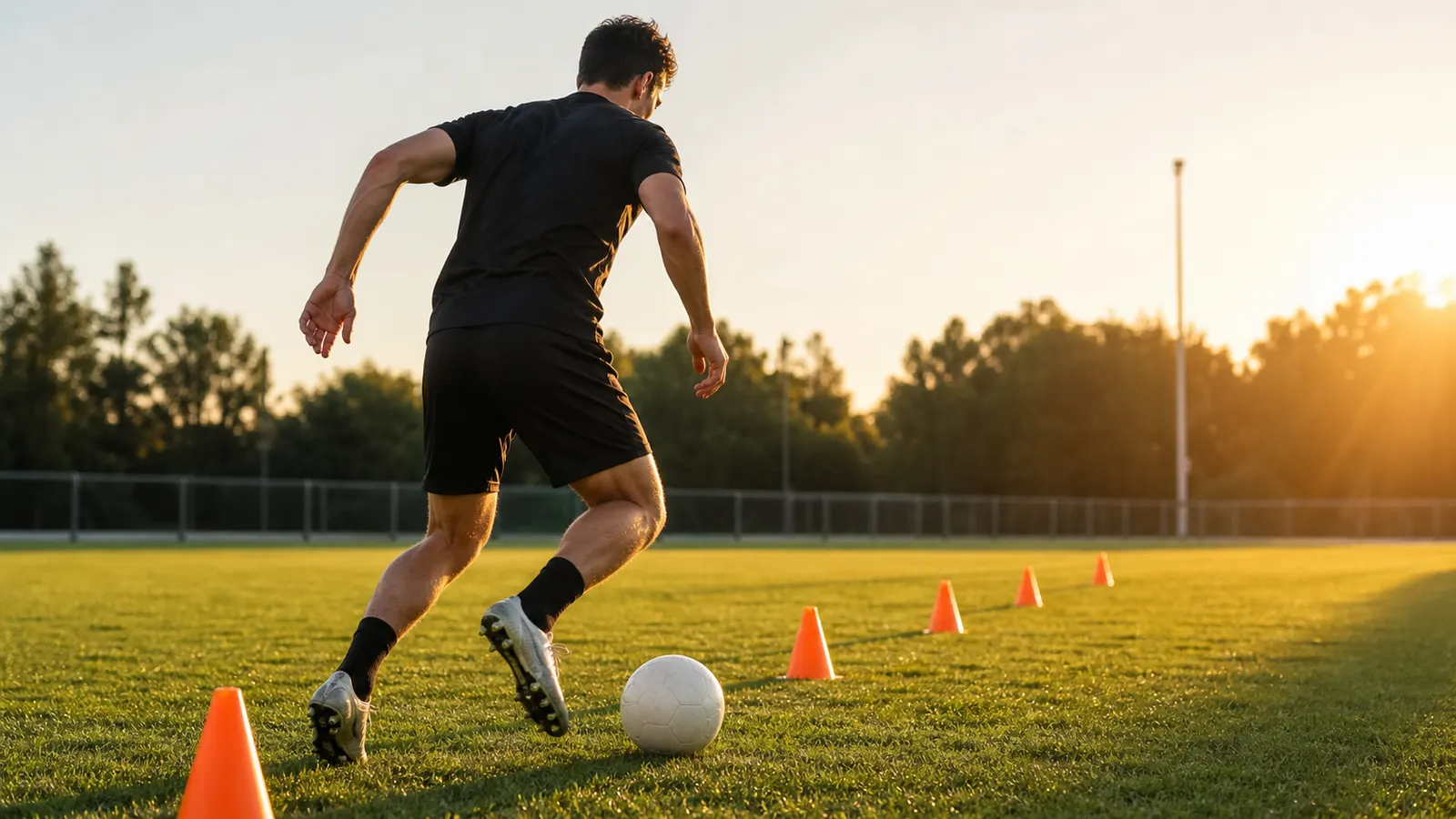
TL;DR. Lionel Messi's exact private workout routine is not publicly verified. The better answer is to study what his public training history, former staff comments, and soccer physiology tell us: Messi's game depends on short explosive accelerations, sharp deceleration, rapid changes of direction, elite ball control, constant scanning, and careful recovery. A realistic "Messi-inspired" plan is not a bodybuilding split. It is a soccer plan: acceleration drills, agility and deceleration work, technical ball work, lower-body strength, core stability, mobility, easy aerobic conditioning, and recovery. The sample week below gives you that structure without pretending it is Messi's literal private program.
There is a whole genre of celebrity workout content that turns famous athletes into tidy sets and reps. Messi does not fit that format well.
His greatness has never looked like the biggest body in the gym. It looks like five steps that separate him from a defender, a cut that changes the angle of the entire play, a pause that makes everyone else move first, and then a burst into space. That is a different fitness profile from "chest day, back day, arm day." It is lower-body power, braking strength, balance, hip mobility, trunk control, repeated sprint ability, technical skill, and recovery capacity all layered together.
This article separates what is actually supported from what is internet folklore, then turns the supported pieces into a practical routine for regular players.
A note before reading. This article is general fitness education, not personal training, medical advice, or a claim to know Messi's private plan. If you are new to sprinting, returning from injury, managing pain, or have cardiovascular risk factors, get cleared by a qualified professional before starting high-intensity soccer training. Sprinting and cutting drills are powerful because they are stressful. Build up gradually.
What reliable sources actually say
The strongest sources do not publish a complete Messi weekly training calendar. They give us a profile.
Messi's career context is unique. FC Barcelona's official profile describes him as one of the club's defining players after coming through La Masia and setting the club's major appearance and scoring records1. That matters because his training was shaped inside an elite football environment for decades, not from a generic gym template.
Former Barcelona physio Juanjo Brau emphasizes perception, timing, and energy management. In a 2026 Cadena SER interview, Brau described Messi as seeing the game almost in slow motion and knowing where space will be before it exists2. That is not a biceps-curl insight. It points to decision speed, scanning, body control, and the ability to save energy until the exact moment a high-value action appears.
Messi's nutrition story is usually traced to Giuliano Poser. AS, citing EFE, reported Poser's emphasis on water, olive oil, whole grains, fresh fruit and vegetables, nuts and seeds, while reducing sugar and refined flour3. It is easy to overstate this as a magic diet. The more reasonable takeaway is that elite performance is supported by boring consistency: hydration, minimally processed foods, enough carbohydrate for training, enough protein for recovery, and fewer foods that make energy and digestion harder to manage.
Soccer physiology supports the same picture. A classic review in Sports Medicine describes soccer as a sport that mixes aerobic endurance with repeated explosive actions: sprinting, jumping, kicking, turning, tackling, and changing pace4. In other words, a footballer needs an engine and a spark. Messi's visible gift is the spark, but the spark only matters because he can repeat it at the right time.
For everyday readers, public-health guidelines still apply. The CDC recommends at least 150 minutes per week of moderate-intensity aerobic activity plus muscle-strengthening work on 2 or more days per week for adults5. A Messi-inspired routine should sit inside that broader safety frame rather than becoming all-out sprint work every day.
The honest summary: we can describe the training qualities behind Messi's game. We cannot honestly say, "Messi does exactly this workout every Monday."
The training qualities behind Messi's game
If you were building a training plan around the way Messi plays, you would prioritize six qualities.
1. First-step acceleration. Messi's separation often happens in the first 5 to 10 meters. That means starting mechanics, shin angle, hip drive, and the ability to apply force quickly into the ground.
2. Deceleration and re-acceleration. The signature move is not just speed. It is stopping, cutting, and restarting before the defender can reset. That requires eccentric strength in the quads, hamstrings, glutes, calves, adductors, and trunk.
3. Ball control at high speed. Many players can sprint. Fewer can sprint while the ball stays close enough to change direction in one touch. Technical work cannot be separated from fitness work for a footballer.
4. Balance and core control. Messi often plays through contact while staying upright. That is not just "abs." It is trunk stiffness, hip stability, single-leg strength, and the ability to keep the torso organized while the lower body changes direction.
5. Aerobic base and repeated effort. Messi is famous for walking during matches, but that does not mean he is unfit. Walking can be tactical energy management. The important training point is that he can preserve energy, then explode repeatedly when the game demands it.
6. Recovery and availability. High-level soccer seasons punish soft tissue. The routine has to include mobility, prehab, nutrition, sleep, and load management. Training hard only helps if you can keep training.
That is the frame for the routine below.
What a Messi-inspired workout is not
Before getting into the plan, it helps to clear away the wrong version.
A Messi-inspired workout is not a bodybuilding split. Big upper-body size is not the goal. Extra mass can become baggage if it does not improve speed, balance, or resilience.
It is not daily max sprinting. Sprinting is a high-stress skill. If you go all-out every day, your hamstrings, calves, Achilles tendons, hips, and groin will usually complain before your fitness improves.
It is not random cone drills until you are tired. Agility is not just sweating around cones. It is the ability to brake, read information, choose a direction, and accelerate again.
It is not only ball work. Technical skill is central, but soccer performance also depends on strength, conditioning, and durability.
The best version is simple: two high-intensity field days, two strength or prehab days, one technical conditioning day, one easy recovery day, and one true rest day.
The 6-day Messi-inspired soccer routine
Use this as a template for a recreational or intermediate player. If you already play matches, replace one of the high-intensity days with your match.
| Day | Focus | Main work |
|---|---|---|
| Day 1 | Acceleration + ball mastery | Short sprints, dribbling starts, first-touch work |
| Day 2 | Strength + prehab | Lower-body strength, core, adductors, calves |
| Day 3 | Technical aerobic work | Easy run or bike plus long ball-control session |
| Day 4 | Agility + decision-making | Deceleration, cuts, reaction drills, 1v1 patterns |
| Day 5 | Repeated sprint + finishing | Sprint intervals, dribble-to-shot, small-sided play |
| Day 6 | Recovery | Mobility, walking, light ball touches |
| Day 7 | Rest | Full rest or very easy walking |
If you need a 5-day version, remove Day 5 or combine it lightly with Day 4. If you need a 7-day version, make Day 7 a gentle walk and mobility day, not another hard workout.
Day 1: acceleration and close control
This is the most "Messi-like" physical session: short, sharp, low-volume, and technically clean.
Warm-up: 12 to 15 minutes
- 5 minutes easy jog or brisk walk
- Dynamic mobility: leg swings, hip circles, ankle rocks, world's greatest stretch
- Activation: 2 sets of 10 glute bridges, 10 calf raises, 10 bodyweight squats
- Build-up runs: 4 x 20 meters at 50%, 60%, 70%, and 80% speed
Acceleration block
Keep the distances short. Rest long enough that each rep is fast.
- 6 x 5-meter starts from a standing position
- 5 x 10-meter starts from a staggered stance
- 4 x 15-meter accelerations with a slow walk-back recovery
Coaching cues:
- Push the ground behind you.
- Keep the first steps short and powerful.
- Do not pop upright immediately.
- Stop the set if speed drops noticeably.
Ball acceleration block
- 6 x 10 meters dribbling from a dead stop
- 5 x 10 meters with one feint before accelerating
- 4 x 15 meters, touch the ball every 1 to 2 steps
The goal is not to dribble as far ahead as possible. The goal is to accelerate while keeping the ball close enough to cut.
Technical finisher
Set up 4 to 6 cones in a loose diagonal line.
- 5 rounds of slalom dribbling through the cones
- After the last cone, accelerate for 5 meters
- Rest 45 to 60 seconds between rounds
Stop while your touches are still crisp. Sloppy touches are not a badge of effort; they are a sign the technical work is done.
Day 2: lower-body strength and prehab
Messi's visible game is light and fast, but that kind of movement still needs strength. The goal here is not a maximal powerlifting session. The goal is strong legs, stable hips, resilient calves, and a trunk that does not collapse when you cut.
Main strength work
Choose loads that leave 2 to 3 reps in reserve.
- Split squat: 3 x 6 to 8 each leg
- Romanian deadlift: 3 x 6 to 8
- Step-up: 3 x 8 each leg
- Single-leg calf raise: 3 x 10 to 15 each side
- Copenhagen side plank or short-lever adductor plank: 2 x 15 to 25 seconds each side
- Dead bug or hollow hold: 3 x 8 to 12 controlled reps
Why this matters
Acceleration asks the glutes and hamstrings to create force. Cutting asks the quads, adductors, calves, and trunk to absorb force. A soccer player who only trains forward speed but ignores braking strength is building half the system.
Keep this session controlled. You should leave feeling trained, not destroyed.
Day 3: technical aerobic conditioning
This is the engine day. It should feel almost too easy.
Option A: easy aerobic work
- 30 to 45 minutes easy jog, bike, row, or incline walk
- Intensity: conversational pace
Option B: ball-based aerobic work
If you prefer to stay on the field:
- 10 minutes easy juggling, wall passes, and first touches
- 15 minutes continuous dribbling at low intensity
- 10 minutes passing against a wall, alternating feet
- 5 minutes very easy cooldown
The point is to build aerobic capacity without adding more sprint stress. Soccer players need hard days, but they also need enough easy volume to recover between hard efforts.
Day 4: agility, deceleration, and decision-making
This is where "cone drills" become useful only if they include braking and choices.
Warm-up
Repeat the Day 1 warm-up, then add:
- 2 x 10 meters side shuffle each direction
- 2 x 10 meters backpedal to forward run
- 3 easy cuts each side
Deceleration block
- 5 x 10-meter run to controlled stop
- 4 x 10-meter run to stop, then backpedal 5 meters
- 4 x 10-meter run to stop, cut 45 degrees, accelerate 5 meters
Coaching cues:
- Lower the hips before the stop.
- Keep knees tracking over toes.
- Brake in multiple short steps, not one huge reaching step.
- Stay balanced enough that you could pass immediately.
Reaction agility block
Use a partner if possible. If not, use a phone timer app with random audio cues.
- Set three gates: left, center, right
- Start 5 meters away
- On the cue, accelerate through the called gate
- 8 to 12 total reps, full recovery between reps
This is more soccer-specific than memorized ladder footwork because the body has to respond to information.
Ball decision block
- Dribble slowly toward three cones
- Have a partner call left, right, or split
- Cut and accelerate for 5 meters
- 8 to 10 reps
If you train alone, assign each cone a number and use a random number generator. The goal is not just feet. It is eyes, choice, and execution.
Day 5: repeated sprint and finishing
This is the hardest field session of the week. Do not place it the day before a match.
Repeated sprint block
- 2 sets of 6 x 20-meter sprints
- Rest 25 to 35 seconds between reps
- Rest 3 minutes between sets
You should be fast, not staggering. If sprint quality collapses, cut the set short.
Dribble-to-shot block
If you have access to a goal:
- Start 20 meters out
- Dribble through 3 cones
- Accelerate out of the last cone
- Finish with a shot
- 8 to 12 reps
If you do not have a goal, pass hard into a wall target or small gate after the final touch.
Small-sided play
If you have teammates, replace the dribble-to-shot block with 3 to 5 rounds of small-sided play:
- 3v3, 4v4, or 5v5
- 3 to 4 minutes per round
- 2 minutes rest
Small-sided games are valuable because they blend conditioning with perception, pressure, passing angles, and decision-making.
Day 6: recovery, mobility, and easy touches
This day should make tomorrow easier.
- 20 to 40 minutes easy walking
- 8 to 12 minutes mobility: hips, calves, hamstrings, adductors, thoracic rotation
- 10 minutes light ball touches or juggling
- Optional: gentle breathing work or stretching before bed
This is also where nutrition and hydration matter. Poser's reported emphasis on water, olive oil, whole grains, fruits, vegetables, nuts, and seeds is not exotic3. It is the kind of eating pattern that supports training without making recovery harder than it needs to be.
For most active adults, the simple recovery checklist is:
- Eat enough total calories for your goal.
- Get protein at each meal.
- Include carbohydrate around hard training days.
- Hydrate consistently.
- Sleep enough that hard sessions are productive.
You do not need to copy a celebrity diet. You need a diet that lets you train well and recover.
How to scale the routine
If you are a beginner
Start with 3 days per week:
- Day 1: acceleration and ball control, half volume
- Day 2: strength and prehab
- Day 3: easy aerobic ball work
Do this for 4 weeks before adding more sprinting. Tendons and hamstrings adapt more slowly than motivation.
If you already play once per week
Treat the match as your hardest conditioning day.
A better week:
- One acceleration day
- One strength day
- One easy technical aerobic day
- One lighter mobility/prehab day
- Match day
- Rest day
Do not stack a repeated sprint day right next to a match unless you are conditioned for that load.
If fat loss is also a goal
Do not turn every soccer workout into punishment. Keep the sprint work high quality, then create most of the calorie deficit through food awareness and easy activity like walking.
Soccer conditioning can support fat loss, but aggressive dieting plus sprinting is a rough combination. Under-fueled sprint work increases the chance that training feels terrible and recovery gets messy.
If muscle gain is also a goal
Keep two strength days per week, raise protein, and do not let field work consume every recovery resource. You can build useful muscle for soccer, but chasing large scale weight gains may slow you down if the added mass does not improve your movement.
The biggest mistakes people make copying athlete routines
They copy intensity without copying preparation. Elite athletes have years of tissue adaptation, coaching, treatment, and monitoring. A regular person copying the hardest drill is not copying the system around the drill.
They sprint before they can brake. Deceleration is the hidden half of speed training. If you cannot stop cleanly, cutting harder is not the answer.
They ignore easy days. Messi's public image includes walking during matches, but that is not laziness. It is energy management. Training needs the same idea: spend hard effort where it pays, recover where it does not.
They separate skill from fitness. Soccer fitness without the ball can help, but the game is technical. Add ball work as soon as quality allows.
They chase soreness. Soreness is not the goal. Better acceleration, cleaner cuts, stronger legs, more consistent touches, and better recovery are the goal.
Frequently asked questions
What is Lionel Messi's exact workout routine?
Messi's exact private routine is not publicly verified. Public sources support a general profile: football-specific training, explosive acceleration, agility, technical ball work, careful recovery, and disciplined nutrition. Any article claiming to know his exact weekly sets and reps should be treated cautiously unless it cites a primary source from Messi or his staff.
Does Messi lift weights?
Elite footballers typically use strength work, but their gym training is usually built around performance: lower-body strength, injury prevention, trunk stability, hip control, power, and recovery. For a Messi-inspired routine, the gym should support speed and durability rather than chase maximum size.
Why does Messi walk so much during games?
Walking can be tactical. It lets a player scan, conserve energy, and wait for the moment when a short burst matters. Brau's comments about Messi reading space before it appears fit this interpretation2. The lesson for training is not "avoid conditioning." It is "condition yourself so you can choose when to explode."
How many days per week should I train like this?
Most recreational players should start with 3 to 5 training days per week, including only 1 to 2 high-intensity sprint or agility days. Add volume slowly. If you also play matches, the match counts as a hard day.
Should I do long runs for soccer?
Some easy aerobic work helps, but long slow running should not crowd out speed, agility, strength, and ball work. Soccer is intermittent. You need an aerobic base, but you also need repeated high-intensity actions.
What should I eat for a Messi-inspired routine?
Keep it boring and effective: enough calories for your goal, protein at meals, carbs around hard sessions, fruits and vegetables, healthy fats, and consistent hydration. Poser's reported nutrition advice for Messi emphasized minimally processed staples rather than a complicated supplement stack3.
Can this routine help with weight loss?
It can help by increasing activity and preserving athletic movement, but food intake still drives most weight change. The smart approach is to use training for performance and health, then use mindful food tracking to understand calories, protein, and weekly trends.
Where Mindful fits
Training like a footballer creates a lot of moving parts: hard days, easy days, hunger changes, recovery needs, protein, carbs, and body-weight trends. The goal is not to make food clinical. It is to see whether your eating supports the kind of training you are asking your body to do.
Mindful can help you track meals, calories, macros, and activity in one place, so you can notice patterns: whether sprint days leave you under-fueled, whether protein is consistent, whether recovery days turn into mindless snacking, and whether your weight trend matches your goal.
If you want to train hard without losing the plot around food, that is exactly the kind of visibility Mindful is built for.
References
Footnotes
-
FC Barcelona. "Leo Messi." Official FC Barcelona profile and career summary. Source ↩
-
Cadena SER. "Juanjo Brau: 'Messi quan juga ho veu tot a camera lenta'." April 2026. Former FC Barcelona physiotherapist Juanjo Brau discusses Messi's perception, space awareness, physical qualities, and career management. Source ↩ ↩2
-
AS / EFE. "The five foods behind Lionel Messi's success." April 2017. Nutrition specialist Giuliano Poser describes the dietary principles he used with Messi, including hydration, olive oil, whole grains, fresh produce, nuts and seeds, and reducing sugar and refined flour. Source ↩ ↩2 ↩3
-
Stolen T, Chamari K, Castagna C, Wisloff U. "Physiology of soccer: an update." Sports Medicine 35(6):501-536. 2005. PubMed ↩
-
Centers for Disease Control and Prevention. "Adult Activity: An Overview." CDC physical activity guidance for adults, including weekly aerobic activity and muscle-strengthening recommendations. Source ↩