Kylian Mbappé Workout Routine: A Speed Plan Inspired by His Game
Kylian Mbappé's exact private workout routine is not public, but his game points to acceleration, repeated sprint ability, finishing, strength, mobility, recovery, and smart nutrition. Here's a sourced Mbappé-inspired speed plan.
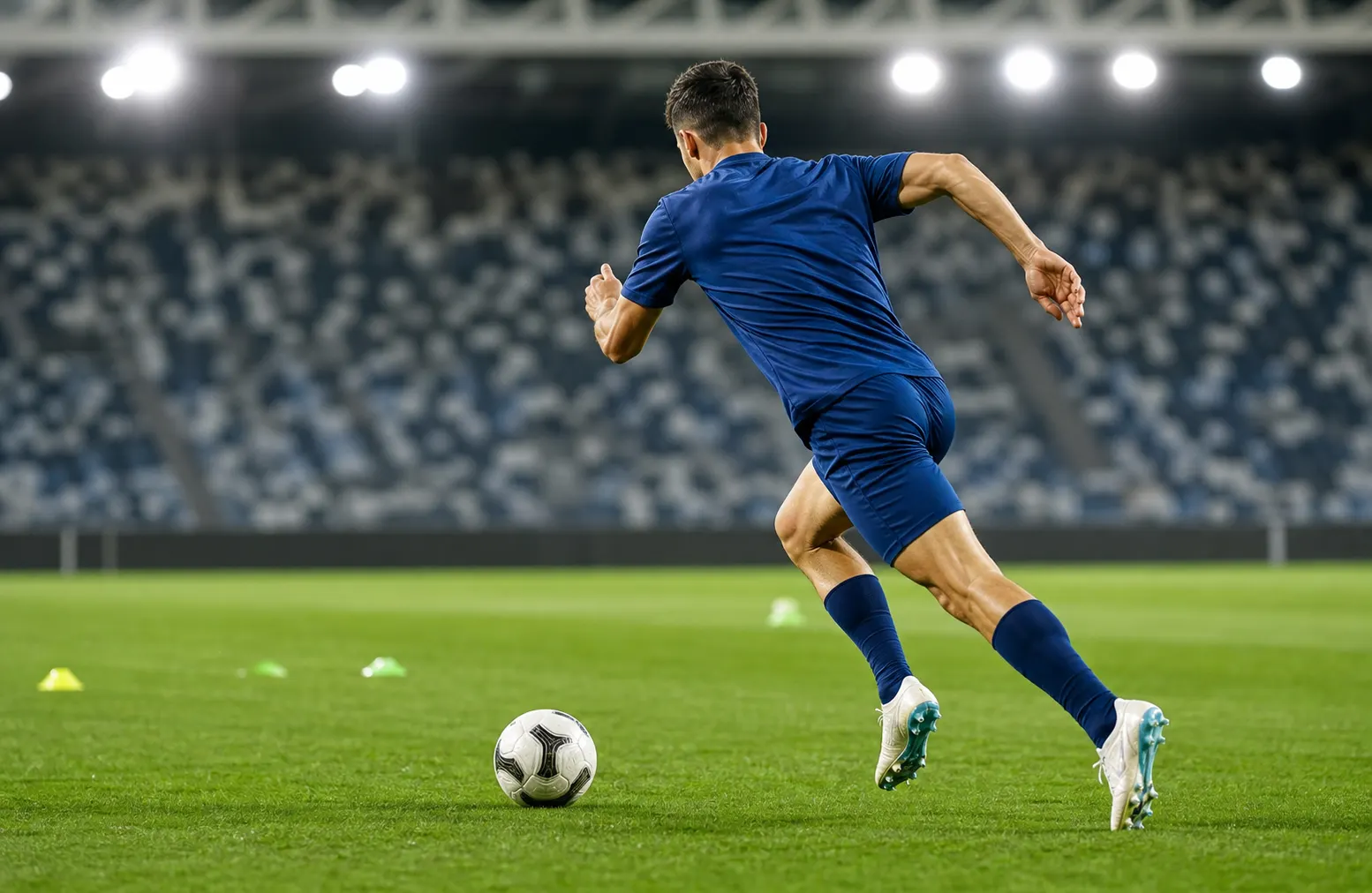
TL;DR. Kylian Mbappé's exact private workout routine is not publicly verified. What is public: Real Madrid lists him as a 1.78 m, 75 kg forward1, and the public discussion around his pace has often focused on explosive runs rather than a published gym plan. The reliable way to build a useful article is to separate sourced facts from practical training. A Mbappé-inspired routine should emphasize short acceleration, max-velocity mechanics, repeated sprint ability, deceleration, change of direction, ball-carrying, finishing, lower-body strength, hamstring/adductor/calf resilience, easy aerobic work, sleep, hydration, and enough food to recover.
The routine below is not Mbappé's literal private program. It is a researched soccer plan inspired by the physical qualities his role demands: a forward who can separate in the first steps, carry the ball at speed, attack space, finish under pressure, and repeat explosive actions across a match.
Celebrity workout articles often fail in the same way: they turn a private elite environment into a neat list of sets and reps.
That is not how professional soccer works. A player like Mbappé is not just "doing speed drills." His weekly load changes with matches, travel, soft-tissue status, tactical work, gym work, recovery data, medical staff input, and the club calendar. No responsible article can claim to know the exact session he does on a random Tuesday unless Mbappé or his staff publish it directly.
So this article does something more useful. First, it explains what reliable sources actually support. Then it turns those supported training qualities into a practical 5- to 7-day routine readers can adapt.
A note before reading. This is general fitness education, not personal training, medical advice, or a claim to know Mbappé's private plan. Sprinting, cutting, and repeated high-intensity work are stressful. If you are new to training, returning from injury, dealing with pain, or managing a health condition, get clearance from a qualified professional and build volume gradually.
What reliable sources actually say
The strongest sources do not publish a complete Mbappé workout calendar. They give us a performance profile.
Real Madrid gives the body-size and role anchor. Mbappé's official Real Madrid profile lists him as a forward, 1.78 m, and 75 kg1. That does not reveal his workout routine, but it helps keep the training discussion grounded. A plan for a fast 75 kg forward should not look like a bodybuilder's mass phase or a marathoner's distance plan.
Public speed claims need careful wording. AS analyzed the viral "Mbappé faster than Usain Bolt" comparison from his 2018 World Cup run against Argentina and treated the numbers as an estimate from a match action, not a laboratory top-speed test2. That distinction matters. Mbappé is obviously fast, but the training takeaway is not "chase a headline speed number." It is to train acceleration, upright sprint mechanics, and the ability to use speed with a ball and a defender nearby.
Soccer physiology supports a mixed plan. A review in Sports Medicine describes soccer as a sport that combines aerobic endurance with repeated explosive actions: sprinting, jumping, kicking, turning, tackling, and changing pace3. That is the blueprint for the routine below. A forward needs an aerobic base, but the decisive moments often come from short, violent bursts.
Reader safety still matters. The CDC's adult activity guidance recommends at least 150 minutes per week of moderate-intensity aerobic activity plus muscle-strengthening work on 2 or more days per week4. A Mbappé-inspired routine should fit inside that broader frame instead of becoming all-out sprint work every day.
Strength work belongs in the durability conversation. A British Journal of Sports Medicine systematic review and meta-analysis found that exercise interventions can reduce sports-injury risk, with strength training showing a particularly strong preventive signal5. That does not mean one exercise prevents every injury. It does support including progressive strength and prehab work instead of only running fast.
Nutrition and recovery have to support the work. Mbappé's exact daily diet is not public. Sports nutrition guidance from the Academy of Nutrition and Dietetics, Dietitians of Canada, and the American College of Sports Medicine recommends scaling carbohydrate intake to training load, and the International Society of Sports Nutrition position stand gives a broad protein range for exercising people67. The principle is simple: do not copy celebrity myths. Build habits that support training, recovery, and your own body composition goal.
The honest summary: we can describe the training qualities behind Mbappé's game. We cannot honestly say, "Mbappé does exactly this workout every week."
The training qualities behind Mbappé's game
A Mbappé-inspired plan should train the qualities a modern explosive forward needs, not just the qualities that look dramatic in a highlight clip.
1. First-step acceleration. Separation often starts in the first 5 to 10 meters. This is about body angle, shin angle, hip drive, stiffness through the trunk, and applying force backward into the ground.
2. Max-velocity mechanics. A forward also needs open-field speed. That means upright sprint posture, front-side mechanics, relaxed shoulders, fast ground contact, and enough hamstring resilience to tolerate high-speed running.
3. Repeated sprint ability. Soccer is not one sprint. It is sprint, recover, scan, press, jog, walk, sprint again. The ability to repeat high-intensity actions is one reason the plan includes both hard intervals and easy aerobic work.
4. Deceleration and change of direction. Speed only helps if you can brake. A forward who cannot stop, cut, and re-accelerate is predictable. Deceleration asks a lot from the quads, calves, adductors, glutes, hamstrings, hips, and trunk.
5. Ball-carrying at speed. Sprinting without the ball is simpler than sprinting while keeping the ball close enough to pass, shoot, cut, or absorb contact. Fitness and technical work have to overlap.
6. Finishing under fatigue. A forward's workout should not end with random conditioning every time. It should include actions that look like football: sprint into space, control the ball, make a decision, and finish.
7. Strength and prehab. Lower-body strength, hamstring work, adductor work, calf capacity, trunk control, and hip mobility help turn speed into something repeatable.
8. Recovery. Elite soccer seasons are dense. The ordinary reader does not need a club recovery room, but the principle transfers: sleep, hydration, easy days, mobility, and food matter because they decide whether hard training actually sticks.
That gives us the structure for the plan.
What a Mbappé-inspired workout is not
A Mbappé-inspired workout is not a bodybuilding split. Bigger arms and a heavier upper body do not automatically make a forward better. Extra mass has to pay rent in speed, strength, or durability.
It is not only ladder drills. Fast feet are useful, but agility is bigger than foot speed. The real skill is reading information, braking, cutting, and accelerating again at the right moment.
It is not daily max sprinting. High-speed running is valuable because it is intense. That also makes it risky when volume jumps too quickly. Hamstrings, calves, Achilles tendons, hip flexors, and groin tissues need gradual exposure.
It is not just running until tired. The goal is quality: faster starts, cleaner mechanics, sharper cuts, more controlled ball touches, and better recovery between efforts.
It is not a guarantee of professional performance. Mbappé's level is built from years of elite development, coaching, professional medical support, tactical intelligence, and a competitive environment most people cannot copy.
The useful version is simpler: two core high-speed field days, two strength or prehab days, one technical aerobic day, one recovery day, and one optional advanced repeated-sprint day for readers who already tolerate sprint work well.
The 6-day Mbappé-inspired soccer routine
Use this as a template for a recreational or intermediate player. If you already play a match, count the match as a hard day and remove one sprint-heavy session.
| Day | Focus | Main work |
|---|---|---|
| Day 1 | Acceleration + ball-carrying | Short starts, dribble accelerations, first-touch work |
| Day 2 | Strength + prehab | Lower-body strength, hamstrings, adductors, calves, core |
| Day 3 | Technical aerobic work | Easy run, bike, or continuous low-intensity ball work |
| Day 4 | Max velocity + finishing | Sprint mechanics, flying sprints, runs into shots |
| Day 5 | Optional advanced agility + repeated sprint | Deceleration, reaction cuts, repeated sprint intervals |
| Day 6 | Recovery | Mobility, walking, light touches, hydration, sleep |
| Day 7 | Rest or match | Full rest, match day, or very easy walking |
For most readers, Day 5 is optional. Add it only after several weeks of sprint exposure, and separate it from Day 4 by 48 hours when possible. If you need a 5-day version, remove Day 5 or turn Day 6 into complete rest. If you need a 7-day version, make the extra day low intensity. Do not add another sprint day just because the schedule has an empty box.
Day 1: acceleration and ball-carrying
This is the first-step session. Keep the volume low enough that every rep is fast.
Warm-up: 12 to 15 minutes
- 5 minutes easy jog, bike, or brisk walk
- Dynamic mobility: leg swings, hip circles, ankle rocks, world's greatest stretch
- Activation: 2 sets of 10 glute bridges, 10 calf raises, 10 bodyweight squats
- Build-up runs: 4 x 20 meters at 50%, 60%, 70%, and 80% speed
Acceleration block
Rest long enough that each rep feels sharp.
- 6 x 5-meter starts from a standing position
- 5 x 10-meter starts from a staggered stance
- 4 x 15-meter accelerations with a slow walk-back recovery
Coaching cues:
- Push the ground behind you.
- Keep the first steps short and powerful.
- Let the body rise gradually instead of standing upright immediately.
- Stop the set if speed drops or the hamstrings feel tight.
Ball acceleration block
- 6 x 10 meters dribbling from a dead stop
- 5 x 10 meters with one body feint before accelerating
- 4 x 15 meters with a touch every 1 to 2 steps
The goal is not to kick the ball far ahead and chase it. The goal is to accelerate while keeping the ball close enough to cut, pass, or shoot.
First-touch finisher
Set up a cone gate 8 to 12 meters away.
- Start with your back to the gate
- Receive a pass or play the ball off a wall
- Take the first touch into space
- Accelerate through the gate
- Complete 8 to 12 reps, alternating sides
This turns speed into a football action: scan, receive, touch, accelerate.
Day 2: lower-body strength and prehab
The gym work should make speed more useful, not make the body heavier for its own sake. Choose loads that leave 2 to 3 reps in reserve. The exercise choices below are examples; swap in simpler variations if you are new to strength training or do not have coaching.
Main strength work
- Split squat: 3 x 6 to 8 each leg
- Romanian deadlift: 3 x 6 to 8
- Step-up or reverse lunge: 3 x 8 each leg
- Hip thrust or glute bridge: 3 x 8 to 10
- Single-leg calf raise: 3 x 10 to 15 each side
- Copenhagen side plank or short-lever adductor plank: 2 x 15 to 25 seconds each side
- Dead bug, Pallof press, or side plank: 3 controlled sets
Optional hamstring accessory
Pick one:
- Nordic hamstring eccentric: 2 x 3 to 5 slow reps
- Slider leg curl: 2 x 6 to 10
- Stability-ball hamstring curl: 2 x 8 to 12
Do not crush your hamstrings the day before a sprint session. If you are new to hamstring eccentrics, start with very low volume.
Why this matters
Acceleration asks the glutes and hamstrings to produce force. Deceleration asks the quads, adductors, calves, hips, and trunk to absorb force. A forward who trains only sprinting but never trains braking strength is building half the system. The broader injury-prevention literature supports progressive strength training as part of a resilient sports program, though individual exercise selection should be matched to the athlete5.
Day 3: technical aerobic conditioning
This day builds the engine without adding more sprint stress.
Option A: easy aerobic work
- 30 to 45 minutes easy jog, bike, row, or incline walk
- Intensity: conversational pace
Option B: ball-based aerobic work
If you want the session to feel more like football:
- 10 minutes easy juggling, wall passes, and first touches
- 15 minutes continuous low-intensity dribbling
- 10 minutes wall passing, alternating feet
- 5 minutes cooldown walk
This is the day that makes the hard days more sustainable. Soccer physiology is mixed, not purely sprint-based3. Easy aerobic work helps you recover between bursts and tolerate more total football.
Day 4: max velocity and finishing runs
This session teaches fast running without turning the day into a conditioning test.
Warm-up
Repeat the Day 1 warm-up, then add:
- 2 x 20 meters A-skips
- 2 x 20 meters high-knee runs
- 2 x 20 meters straight-leg bounds at low intensity
- 3 progressive strides of 30 meters
Flying sprint block
Flying sprints separate acceleration from top-speed mechanics.
- 4 x 20-meter build-up + 10-meter fast zone
- 3 x 20-meter build-up + 20-meter fast zone
- Rest 2 to 3 minutes between reps
Keep the fast zone smooth. You should feel tall, relaxed, and quick, not tense and wild.
Curved run block
Forwards rarely sprint only in straight lines.
- Set a cone arc toward goal or a target gate
- Run 6 to 8 curved sprints of 15 to 25 meters
- Rest 60 to 90 seconds between reps
Finish under control
If you have a goal:
- Start 25 meters out
- Sprint onto a pass, through ball, or self-played touch
- Finish with 1 to 2 touches
- Complete 8 to 12 reps
If you do not have a goal, pass hard into a wall target or through a small gate after the sprint.
This is where the routine becomes more than track work. A forward's speed has to arrive with timing, touch, and composure.
Day 5: agility, reaction, and repeated sprint ability
This is the hardest field day of the week and should be treated as optional or advanced. Add it only after several weeks of pain-free sprint exposure. Avoid it if you have hamstring, calf, Achilles, hip flexor, or groin soreness, and do not place it the day before a match. When possible, keep at least 48 hours between this session and max-velocity work.
Deceleration block
- 5 x 10-meter run to controlled stop
- 4 x 10-meter run to stop, backpedal 5 meters
- 4 x 10-meter run to stop, cut 45 degrees, accelerate 5 meters
Coaching cues:
- Lower the hips before braking.
- Use multiple short steps instead of one huge reach.
- Keep the chest organized over the hips.
- Leave each rep balanced enough that you could pass immediately.
Reaction agility block
Use a partner if possible. If not, use a random timer or callout app.
- Set three gates: left, center, right
- Start 5 meters away
- On the cue, accelerate through the called gate
- Complete 8 to 12 total reps with full recovery
Memorized cone routes are fine for coordination. Reaction work is closer to football because the body has to respond to information.
Repeated sprint block
- 2 sets of 6 x 20-meter sprints
- Rest 25 to 35 seconds between reps
- Rest 3 minutes between sets
You should be fast, not staggering. If sprint quality collapses, stop the set. Repeated sprint ability is about repeating quality bursts, not proving you can suffer through bad reps.
Small-sided play option
If you have teammates, replace part of the repeated sprint block with:
- 3v3, 4v4, or 5v5
- 3 to 4 minutes per round
- 2 minutes rest
- 3 to 5 rounds
Small-sided play blends conditioning with perception, passing angles, pressing, and decision-making.
Day 6: recovery, mobility, and easy touches
This day should make tomorrow easier.
- 20 to 40 minutes easy walking
- 8 to 12 minutes mobility: calves, hips, hamstrings, adductors, thoracic rotation
- 10 minutes light touches, juggling, or wall passes
- Optional: breathing work or stretching before bed
Recovery is not a soft add-on. It is part of training. The hard sessions create a signal; food, hydration, sleep, and lower-intensity movement help you adapt to it.
For most active adults, a simple recovery checklist is enough:
- Eat enough total calories for your goal.
- Get protein at each meal.
- Place carbohydrates around hard field sessions.
- Hydrate consistently.
- Sleep enough that sprint sessions are productive.
- Do not stack hard sessions when your legs feel flat or painful.
How to scale the routine
If you are a beginner
Start with 3 days per week:
- Day 1: acceleration and ball-carrying, half volume
- Day 2: strength and prehab
- Day 3: easy aerobic ball work
Do that for 4 weeks before adding another sprint day. Motivation adapts faster than tendons.
If you already play once per week
Treat the match as your hardest conditioning day.
A better week:
- One acceleration day
- One strength day
- One easy technical aerobic day
- One lighter mobility/prehab day
- Match day
- Rest day
Do not place repeated sprints within 24 hours of a competitive match unless you are already conditioned for that load.
If fat loss is also a goal
Do not turn every football session into punishment. Keep the sprint work high quality, then create most of the calorie deficit through food awareness and easier activity like walking.
Aggressive dieting plus sprinting is a rough combination. Under-fueled high-speed work can make training feel worse and recovery less predictable.
If muscle gain is also a goal
Keep two strength days per week, raise protein, and keep field volume realistic. You can build useful muscle for soccer, but chasing large weight gain may slow you down if the added mass does not improve movement.
If your legs feel heavy
Cut volume before cutting quality.
- Keep the warm-up.
- Keep 3 to 5 sharp accelerations.
- Remove the conditioning block.
- Finish with easy touches and mobility.
The best athletes are not the ones who turn every day into a test. They are the ones who can train hard, recover, and show up again.
Nutrition and recovery for a Mbappé-inspired week
The workout plan only works if the rest of the day supports it.
For a speed-heavy soccer week, food has three main jobs:
Fuel hard sessions. Carbohydrates matter because soccer includes repeated high-intensity work3. Position-stand guidance recommends higher carbohydrate availability as training duration and intensity rise, so hard field days usually need more rice, pasta, potatoes, oats, bread, fruit, cereal, or sports drink than rest days6.
Repair tissue. Protein at each meal helps support muscle repair. The ISSN position stand gives 1.4-2.0 g/kg/day as a broad protein range for many exercising people and emphasizes distribution across the day7. You do not need a complicated celebrity supplement stack; you need consistency.
Keep digestion predictable. Big salads, high-fat meals, and unfamiliar foods can be perfectly healthy but poorly timed before sprinting. Put easier carbs closer to training and heavier meals farther away.
The same rule applies to food as to training: use the structure, not the celebrity mythology.
The biggest mistakes people make copying elite forwards
They copy intensity without copying the support system. Professional players have years of tissue adaptation, coaching, physiotherapy, monitoring, and staff decisions. Copying only the hardest drill is not copying the program.
They sprint before they can brake. Deceleration is not optional. If you cannot stop cleanly, harder cutting drills are not the answer yet.
They treat speed as only a gym problem. Strength helps, but sprinting is also a skill. You still need exposure to fast running.
They treat speed as only a track problem. A forward has to run fast with a ball, an opponent, a passing angle, and a decision.
They ignore easy days. Soccer requires bursts, but the week needs rhythm. Easy aerobic work, walking, and mobility help the hard sessions stay high quality.
They chase soreness. Soreness is not proof of progress. Cleaner mechanics, faster starts, better repeated efforts, stronger legs, and fewer aches are better signals.
Frequently asked questions
What is Kylian Mbappé's exact workout routine?
Mbappé's exact private workout routine is not publicly verified. Any article claiming to know his exact weekly sets, reps, sprint distances, and gym plan should be treated cautiously unless it cites a primary source from Mbappé, his club, or his staff.
Does Mbappé lift weights?
Elite footballers typically use strength work, but the goal is performance: force production, durability, trunk control, hip stability, hamstring resilience, adductor strength, and recovery. A Mbappé-inspired plan should use the gym to support speed and availability, not chase size for its own sake.
How should I train to get faster for soccer?
Start with quality acceleration work, progressive sprint exposure, strength training, and enough rest. Add ball-carrying and finishing once the running mechanics are controlled. Keep high-speed days to 1 or 2 per week at first.
Should I do long runs for soccer?
Some easy aerobic work helps, but long slow running should not crowd out acceleration, repeated sprint ability, agility, strength, and ball work. Soccer is intermittent, so the best plan combines an aerobic base with explosive actions.
How many days per week should I train like this?
Most recreational players should start with 3 to 5 training days per week, including only 1 to 2 sprint-heavy days. If you also play matches, count the match as a hard day.
Can this routine help with weight loss?
It can help by increasing activity and preserving athletic movement, but food intake still drives most weight change. Use training for performance and health, then use food tracking to understand calories, protein, and weekly trends.
What should I eat with this routine?
Keep it practical: enough total calories for your goal, protein at meals, carbohydrates around hard sessions, fruits and vegetables, healthy fats, and consistent hydration.
Where Mindful fits
Training like a footballer creates moving targets: hard days, easy days, appetite swings, recovery needs, protein, carbohydrates, hydration, and body-weight trends. The goal is not to make food clinical. It is to see whether your eating supports the work you are asking your body to do.
Mindful can help you track meals, calories, macros, and activity in one place, so you can notice patterns: whether sprint days leave you under-fueled, whether protein is consistent, whether recovery days turn into grazing, and whether your weight trend matches your goal.
If you want to train hard without losing the plot around food, that is exactly the kind of visibility Mindful is built for.
References
Footnotes
-
Real Madrid. "Kylian Mbappé." Official Real Madrid first-team profile, including position, height, and weight. Source ↩ ↩2
-
AS. "Did France striker Kylian Mbappé run faster than Usain Bolt?" July 2018. AS analyzes the viral speed comparison around Mbappé's World Cup run against Argentina and why match-action estimates should not be treated as official laboratory top-speed data. Source ↩
-
Stolen T, Chamari K, Castagna C, Wisloff U. "Physiology of soccer: an update." Sports Medicine 35(6):501-536. 2005. PubMed ↩ ↩2 ↩3
-
Centers for Disease Control and Prevention. "Adult Activity: An Overview." CDC physical activity guidance for adults, including weekly aerobic activity and muscle-strengthening recommendations. Source ↩
-
Lauersen JB, Bertelsen DM, Andersen LB. "The effectiveness of exercise interventions to prevent sports injuries: a systematic review and meta-analysis of randomised controlled trials." British Journal of Sports Medicine 48(11):871-877. 2014. DOI ↩ ↩2
-
Thomas DT, Erdman KA, Burke LM. "Nutrition and Athletic Performance." Medicine & Science in Sports & Exercise 48(3):543-568. March 2016. Position stand from the Academy of Nutrition and Dietetics, Dietitians of Canada, and the American College of Sports Medicine. DOI ↩ ↩2
-
Jäger R, Kerksick CM, Campbell BI, et al. "International Society of Sports Nutrition Position Stand: protein and exercise." Journal of the International Society of Sports Nutrition 14:20. June 2017. DOI ↩ ↩2