Best Calorie Tracking Apps in 2026
An honest, research-grounded guide to the calorie tracking apps worth knowing about, including what each one does well, where they fall short, and how to pick the right one for you.
Updated
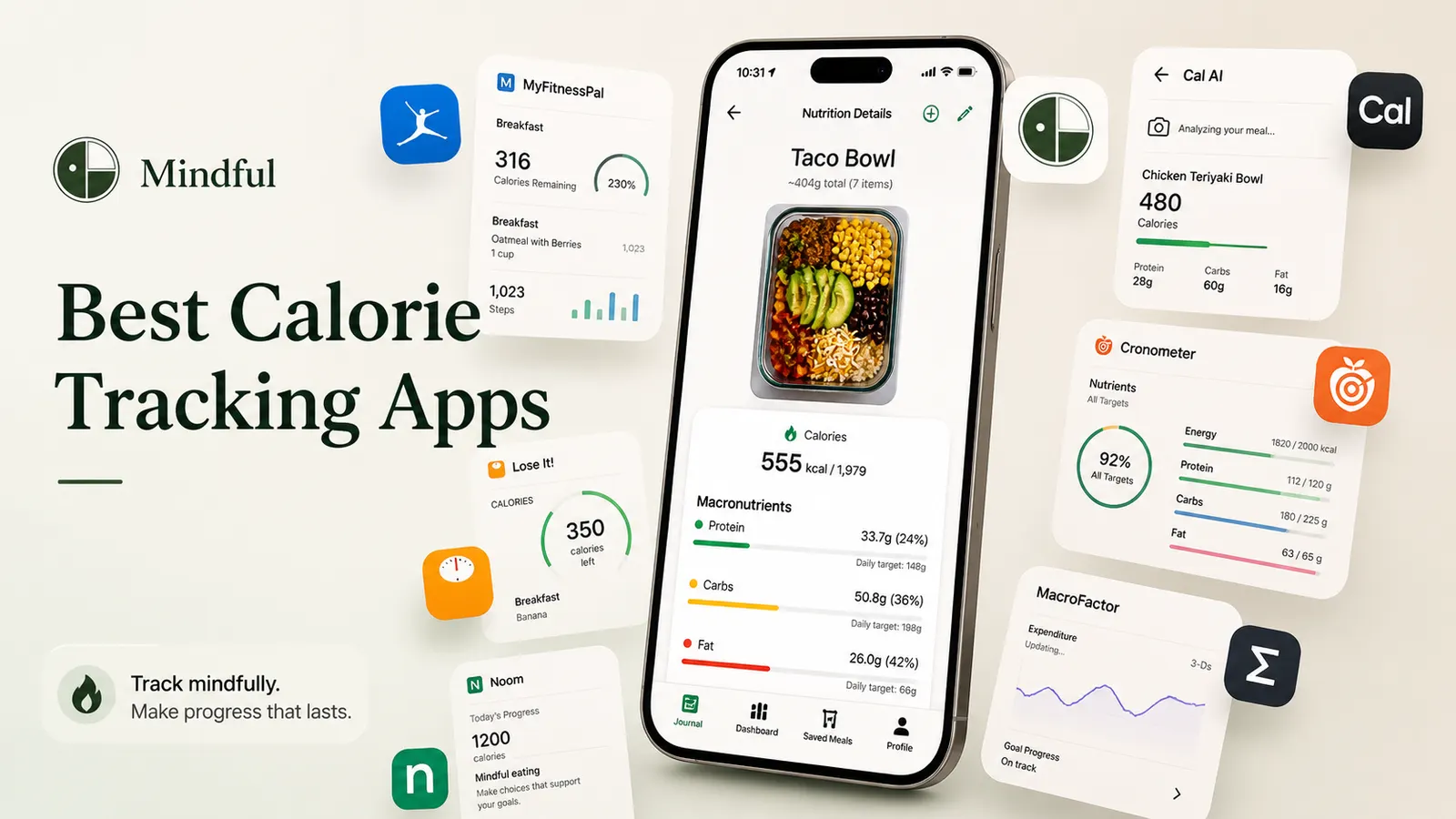
Calorie tracking apps are one of the most downloaded categories in the App Store, and one of the most abandoned. MyFitnessPal alone has over 200 million registered users1, but retention across the category is famously poor, and most users stop logging within a few months. That gap between how many people try these apps and how many actually stick with them is the single most interesting thing about the category.
The apps that are winning today are mostly the ones that have figured out how to reduce that abandonment, either by removing friction (AI photo logging), changing the psychology (adherence-neutral coaching), or specializing for a specific use case (keto, diabetes, mindful eating).
This guide walks through what's available in 2026, how to think about choosing, and what the research actually says about which approaches work long-term.
How calorie tracking apps split into four categories
The category looks chaotic from the outside, with dozens of apps, overlapping feature lists, and similar screenshots, but most of them fall into one of four design philosophies.
The database giants, including MyFitnessPal, Lose It!, FatSecret, and Cronometer, won the 2010s by building enormous food databases. MyFitnessPal has more than 18 million entries2. The trade-off is that many entries are user-submitted, often duplicated, and sometimes inaccurate. These apps lean heavily on manual logging, which is also the friction point that drives most abandonment.
The AI photo trackers, including Cal AI, SnapCalorie, Foodvisor, NutriScan, Bitesnap, and Calorie Mama, emerged starting around 2023 with a single promise: snap a photo, get your calories. The technology has gotten genuinely useful, but accuracy varies. A 2024 University of Sydney study tested seven apps with AI-enabled food image recognition and found strong component recognition in the best-performing apps, but inaccurate automatic energy estimates, especially for mixed and culturally diverse dishes3.
The coaching and psychology apps, including Noom, Weight Watchers, MacroFactor, and HealthifyMe, wrap tracking inside a behavior-change program. They sell themselves as a system rather than just a logbook. MacroFactor stands out in this group as the most algorithmically rigorous, adjusting calorie targets weekly based on actual weight trends.
The minimalists and mindful eaters, including Calory, Ate, See How You Eat, and Recovery Record, explicitly pull back from heavy tracking. Some don't track calories at all. They exist because there's a real, well-documented downside to obsessive tracking: peer-reviewed research has linked heavy use of apps like MyFitnessPal to disordered eating behavior, particularly among users tracking for weight-control or body-shape reasons45. For some people, less tracking is the more useful version of tracking.
No category is objectively right. Which one fits depends on what you're actually trying to do.
A practical way to compare logging workflows
Choose a packaged food you eat regularly and keep its label beside you. Log the same portion in each app you are considering, then change the amount. Check whether you can find the serving size, inspect the source, correct the entry, and reuse the food later. These are suggested comparison steps; the table below is not the result of a controlled hands-on benchmark.
Mindful's documented yogurt example shows the food, portion, and preparation assumptions behind an entry. Its confidence scores describe the model's assessment, not an independently measured accuracy percentage. See the meal correction examples for the questions to ask before saving.
If you are replacing an existing diary, our MyFitnessPal alternatives guide compares the available approaches by use case. If you are still deciding whether to track, start with whether calorie tracking fits your situation.
The major apps at a glance
Swipe across to read the full table.
| App | Logging | Strengths | Watch-outs |
|---|---|---|---|
| Mindful | Typed meal descriptions; optional photo, barcode, label scan, and manual entry | Write what you ate to estimate calories and macros; review assumptions and sources; Apple Health integration and widgets | Currently available on iPhone; nutrition estimates need review |
| MyFitnessPal | Manual + AI scan | Largest food database (18M+); broad device support | User-submitted data is often inaccurate; diary workflow can feel manual; linked in research to disordered eating |
| Cal AI | Photo, barcode, label, voice | Fast photo logging; clean UI; viral momentum | Independent hands-on tests have found serious underestimation on some foods6; fewer visible source details than review-first workflows |
| SnapCalorie | Photo, voice, barcode | Company reports about 15% mean calorie error; 30+ micronutrients; depth-sensor support | Accuracy claims rely partly on company materials; learning curve |
| MacroFactor | Manual + barcode + AI describe | Adaptive coaching that auto-adjusts calorie targets weekly; verified database; science-backed by Stronger By Science | Less photo-first than newer AI apps |
| Cronometer | Manual + barcode | Best-in-class micronutrient tracking; verified database; clinical-grade detail | No AI photo logging; spartan UI; no community |
| Lose It! | Manual + AI photo (Snap It) | Clean UI; growing as a MyFitnessPal alternative | Smaller food database; some users find it tricky to log home-cooked meals |
| Noom | Manual + color-coded foods | Behavioral psychology lessons; coaching; community | Not a tracker-first experience; coaching layer can feel heavier than simple logging |
| Yazio | Manual + barcode | Clean countdown UI; integrated fasting tracker | Limited coaching or education |
| Lifesum | Manual + barcode | Food rating system; meal plans for keto, paleo, Mediterranean, etc. | Ratings can hide the reasoning; broad lifestyle focus can feel less precise |
| Foodvisor | Photo, manual | 20+ language support; dietitian consultations | More coaching-oriented than tracker-first; weaker on non-European cuisines |
| HealthifyMe | Photo (Snap), manual, barcode | Strong Indian/Asian cuisine recognition; AI coach Ria; 11 Indian languages | 3.4-star on Trustpilot; persistent customer service complaints |
| NutriScan | Photo, voice, barcode | Global cuisine recognition; AI nutritionist Monika; 28-day diet plans | Smaller user base; less Western-focused |
| FatSecret | Manual + barcode | Straightforward traditional tracker; community challenges | Cluttered interface |
| Calory | Manual | Beautifully simple; USDA-backed | Very limited features; iOS-first |
| Weight Watchers | Points-based | Established community and accountability; integrated GLP-1 program | Points system isn't true calorie tracking; less granular |
| Carb Manager | Manual + barcode + photo | Best-in-class for keto and low-carb tracking | Niche-focused; less useful outside keto |
| MyNetDiary | Manual + voice + barcode | Food grading system; strong diabetes-focused features | Health-metric depth may be more than casual trackers need |
What the research says about which apps actually work
Self-monitoring is one of the most consistently effective behaviors in the entire nutrition literature. A foundational 2008 study from Kaiser Permanente followed nearly 1,700 adults for six months and found that participants who kept daily food records lost twice as much weight as those who kept no records7. A 2011 systematic review in the Journal of the American Dietetic Association synthesized two decades of similar studies and concluded that consistent self-monitoring of dietary intake is reliably associated with weight-loss success8.
More recent work has added an important nuance. In a 2019 study from the University of Vermont and the University of South Carolina, the most successful participants, those who lost 10% or more of their body weight, averaged just 14.6 minutes per day on tracking by month six. The strongest predictor of success wasn't time spent or accuracy. It was the frequency of logging9.
That distinction matters more than almost anything else when picking an app. The apps that win in the long run aren't the ones with the most features or the largest databases. They're the ones you actually use on a Tuesday in week 14, when the novelty has worn off.
That is a useful way to evaluate a logging workflow: try writing a meal in Mindful, using a photo in a photo-focused app, or reusing a saved meal in your existing tracker. Compare how each fits your routine. The studies above do not establish that one of these apps outperforms the others.
The flip side is also documented. A 2017 study in Eating Behaviors surveyed 493 college students and found a meaningful association between calorie-tracking app use and eating disorder symptomatology10. A separate 2017 study found that 73% of MyFitnessPal users with diagnosed eating disorders perceived the app as contributing to their condition, with that perception correlated with symptom severity4. A 2025 systematic review in Body Image concluded that while these apps benefit some users, they can reinforce obsessive thinking and rigid food rules in vulnerable populations, particularly when used for weight-control or body-shape motives5. That is why the design and framing of calorie tracking matters, especially for people who already feel pulled toward rigid food rules.
The newer generation of apps has started to push against this. Mindful focuses on writing what you ate to track calories, with photos and scanning available as additional options. MacroFactor deliberately doesn't punish users for going over and adjusts goals based on weekly trends instead of daily snapshots. Apps like Ate and See How You Eat drop calorie counting altogether in favor of photo-based reflection. None of these designs are objectively right, but they reflect a real shift in how the field thinks about long-term behavior change.
How AI photo logging actually performs
Photo logging is the headline feature of many newer apps, including Cal AI, SnapCalorie, and Foodvisor, and accuracy varies more than the marketing suggests.
The 2024 University of Sydney study is the best public benchmark to date3. It tested seven apps with AI-enabled image recognition and found:
- Food component recognition varied widely. The best-performing apps recognized food components well, while others struggled even before nutrition estimates were calculated.
- Energy estimates were often inaccurate. Automatic food image recognition produced unreliable calorie estimates across several meals.
- Culturally diverse mixed dishes were especially hard. The paper highlighted large errors for meals like beef pho and pearl milk tea, including energy overestimation of beef pho by as much as 49% and underestimation of pearl milk tea by as much as 76%.
SnapCalorie reports about 15% mean calorie error in its own FAQ, and its team's earlier Nutrition5k research helped establish a public benchmark for automatic nutrition understanding11. Cal AI, a popular AI tracker, has been criticized in independent reviews for serious underestimation on certain foods; a 2025 Lifehacker hands-on test found a Pink Lady apple underestimated by 33% and a mixed salad estimated at 450 calories when the actual total was closer to 800 to 9006.
The takeaway isn't that AI photo logging is bad. It is dramatically faster than manual entry, and the consistency it enables matters more than per-meal precision. You should treat the output as a starting estimate, not a verdict, especially for dishes the app probably wasn't trained on.
How to pick the right app for you
The most useful filter isn't features. It's what kind of user you are.
If you want to write meals to track calories: Mindful turns everyday meal descriptions into calorie and macro estimates. You can review the assumptions and available sources, make corrections, and use photos or scanning as additional options. See how the estimates work.
If you want the deepest data and don't mind manual logging: Cronometer is the gold standard for micronutrient tracking. If you have a medical reason to monitor specific vitamins, minerals, or trace elements, nothing else in the consumer category comes close. The trade-off is a spartan UI and no AI photo logging.
If you want the smartest, most adaptive coaching: MacroFactor's algorithm watches your weight trend and your logged intake, then adjusts your calorie target weekly. It's the most intellectually honest coaching system in the category and the most likely to keep you on track over months.
If photo logging is your top priority: Cal AI and SnapCalorie are options to compare. Mindful also supports photos, while making written meal descriptions the main way to start your journal.
If you want a behavior-change program, not just a tracker: Noom and Weight Watchers offer the most established programs, with coaching and community built in. Both work for the right person.
If you eat global cuisines: HealthifyMe and NutriScan are trained on broader food datasets than the Western-focused apps and tend to outperform them on Indian, Southeast Asian, and similar dishes.
If you're keto or low-carb: Carb Manager is built specifically for this and outperforms general-purpose trackers in this niche.
If you have any history with disordered eating: Most clinical guidance is explicit: calorie tracking apps are generally not the right tool, regardless of how gentle the interface is. The minimalist apps (Ate, See How You Eat) or no app at all are usually safer choices.
If you want the largest food database and you'll tolerate the design: MyFitnessPal still has more entries than anyone else, even if many are user-submitted and the design pushes you toward number-watching.
The bigger picture
The best calorie tracking app for you isn't the one with the most features or the largest database. It's the one you'll still be using in three months, when the novelty has worn off and you're tired and the app needs to fit into a normal life.
The single best thing AI has done for this category is remove enough friction that the act of tracking can fade into the background. The single worst thing it could do is convince people that hyper-precise data is the goal. The research is clear that consistency beats accuracy, weekly trends beat daily totals, and gentle awareness beats anxious accounting. Whichever app you pick, those principles will serve you better than any specific feature list.
Where Mindful fits
Mindful is a food journal for people who want to write what they ate and keep track of calories and macros. Start with an everyday meal description, review the estimate, and save the entry. You can also use a photo or scan packaged food when it helps.
The journal brings your entries and daily totals together, with details you can check and correct. Read how Mindful estimates calories and macros for an example of the food, portion, and preparation breakdown.
References
Footnotes
-
Business of Apps. "MyFitnessPal Revenue and Usage Statistics (2026)." March 2026. Source ↩
-
MyFitnessPal. "Calorie Tracker & BMR Calculator to Reach Your Goals." Company website. Source ↩
-
Li X, Yin A, Choi HY, Chan V, Allman-Farinelli M, Chen J. "Evaluating the Quality and Comparative Validity of Manual Food Logging and Artificial Intelligence-Enabled Food Image Recognition in Apps for Nutrition Care." Nutrients 16(15):2573. August 2024. DOI ↩ ↩2
-
Levinson CA, Fewell L, Brosof LC. "My Fitness Pal calorie tracker usage in the eating disorders." Eating Behaviors 27:14 to 16. 2017. DOI ↩ ↩2
-
Anderberg I, Kemps E, Prichard I. "The link between the use of diet and fitness monitoring apps, body image and disordered eating symptomology: A systematic review." Body Image 52:101836. March 2025. DOI ↩ ↩2
-
Dietz M. "I Used AI-Powered Calorie Counting Apps, and They Were Even Worse Than I Expected." Lifehacker. June 2025. Source ↩ ↩2
-
Hollis JF, Gullion CM, Stevens VJ, et al. "Weight loss during the intensive intervention phase of the weight-loss maintenance trial." American Journal of Preventive Medicine 35(2):118 to 126. August 2008. DOI ↩
-
Burke LE, Wang J, Sereika SM. "Self-Monitoring in Weight Loss: A Systematic Review of the Literature." Journal of the American Dietetic Association 111(1):92 to 102. January 2011. DOI ↩
-
Harvey J, Krukowski R, Priest J, West D. "Log Often, Lose More: Electronic Dietary Self-Monitoring for Weight Loss." Obesity 27(3):380 to 384. March 2019. DOI ↩
-
Simpson CC, Mazzeo SE. "Calorie counting and fitness tracking technology: Associations with eating disorder symptomatology." Eating Behaviors 26:89 to 92. August 2017. DOI ↩
-
SnapCalorie. "FAQ: How accurate is SnapCalorie?" Company FAQ. Source. See also: Thames Q, et al. "Nutrition5k: Towards Automatic Nutritional Understanding of Generic Food." CVPR 2021. ↩